

An off-grid solar system is a self-supplied power system that runs without a utility connection by combining solar panels, power electronics, and (in most cases) energy storage. It produces electricity during daylight, stores surplus in batteries, and uses an inverter to deliver stable AC power for normal appliances. System performance and cost are driven by three variables: daily energy use (kWh/day), peak power (kW), and desired autonomy (hours/days without sun).
In practice, an off-grid design starts with load auditing and load prioritization, then sizes the PV array for seasonal solar resource and the battery for overnight and multi-day coverage, while accounting for conversion losses and component limits. Published benchmarks for grid-tied PV and PV+storage provide a cost baseline; off-grid builds typically add larger storage, additional power-management hardware, and often a generator interface.
For small loads (cabins, workshops, garages), systems around ~2 kW PV + ~10 kWh storage often cover lighting, refrigeration, electronics, and intermittent tool use; whole-house off-grid at typical U.S. consumption implies tens of kWh of storage and ~10+ kW PV, which changes both budget and complexity.
What is an off-grid solar system?
An off-grid solar system is a standalone electrical system that generates and manages electricity on-site without exporting to, importing from, or synchronizing with the utility grid. It combines PV generation with energy storage and/or backup generation so loads stay powered when solar output is low (night, storms, seasonal dips).
Common off-grid use cases include:
- Remote cabins and workshops/garages where utility extension is impractical
- Critical-load independence (medical equipment, telecom, water pumping, refrigeration)
- Sites with unreliable grid service where a “microgrid” approach (PV + battery + generator) maintains power continuity
NREL’s REopt off-grid training materials frame off-grid design around meeting an hourly load profile while minimizing lifecycle energy cost and maintaining reliability constraints (including reserves and controlled load shedding when configured).
How does an off-grid solar power system work?
An off-grid solar power system works by converting sunlight into DC electricity, regulating that electricity for safe charging, storing energy for later use, and converting stored DC power into usable AC power for standard loads.
A practical, component-level flow looks like this:
- PV array produces DC power
- Example benchmark modules: 400 W each, ~21.1% efficiency (module-level) in DOE’s residential reference system.
- Charge controller (or hybrid inverter) regulates charging
- MPPT control tracks the PV operating point for higher daily harvest than a simple regulator in variable sun and temperature.
- Battery stores energy
- Batteries cover overnight loads and solar shortfalls (cloudy periods).
- Battery management limits voltage, current, and temperature to protect cycle life.
- Inverter supplies AC power
- Modern PV inverter peak efficiency commonly sits in the mid-to-high 90% range, while real-world system conversion factors often use a lower “effective” value due to part-load operation and conditions.
- Optional generator + transfer/charger support
- Many off-grid systems use a generator input to reduce required battery/PV oversizing for rare multi-day low-sun events.
In an AC-coupled architecture, PV power is inverted to AC and then re-rectified to DC to charge the battery, adding extra conversion steps; NREL explicitly describes this DC→AC→DC sequence in its off-grid modeling assumptions.
What are the main components of an off-grid solar system?
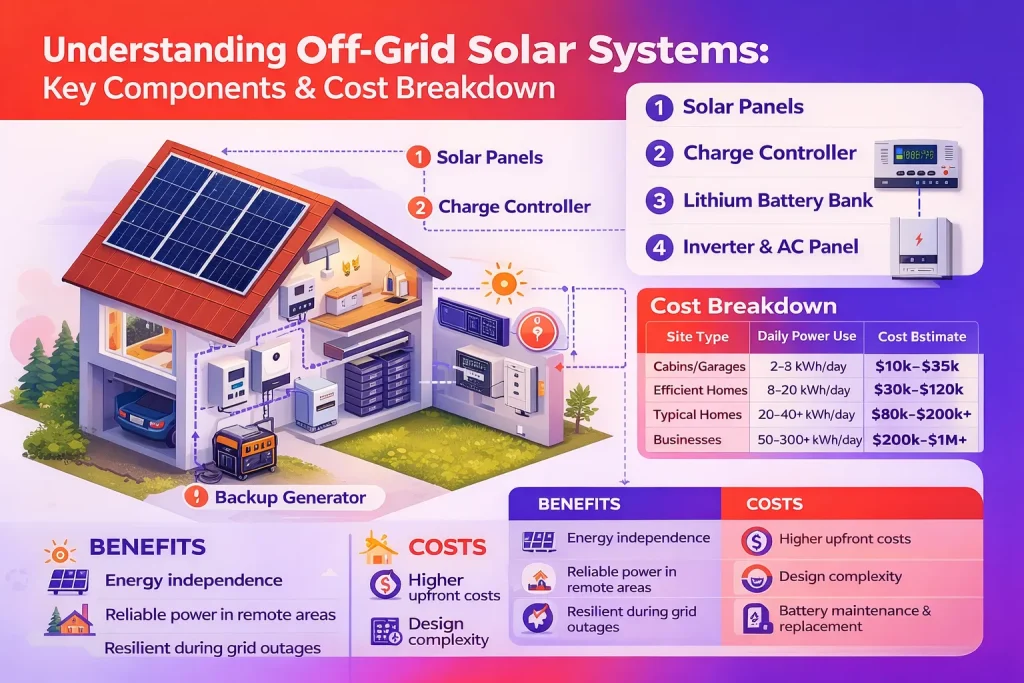
The main components of an off-grid solar system are the PV array, charge control, battery storage, inverter/charger, protection hardware, and distribution, often complemented by a backup generator.
| Component | What it does | Practical sizing anchor |
|---|---|---|
| PV modules + racking | Generates DC power from sunlight | kWdc driven by kWh/day and seasonal sun hours |
| Combiner + DC disconnects + fuses/breakers | Combines strings and provides protection/isolation | Current and voltage ratings matched to array |
| MPPT charge controller or hybrid inverter | Regulates charging, controls PV input | PV input voltage window + max charge current |
| Battery bank (LFP, lead-acid, etc.) | Stores energy for night and low-sun periods | kWh sized by autonomy and allowable DoD |
| Inverter/charger (grid-forming) | Converts DC→AC and manages generator charging | Continuous kW + surge (motor start) |
| AC distribution panel | Breakers and circuits for loads | Mirrors conventional electrical distribution |
| Grounding + surge/lightning protection | Reduces shock/fire risk, limits transient damage | Site-dependent grounding electrode system |
| Monitoring/controls | SOC tracking, fault logs, remote visibility | Improves operational reliability and diagnostics |
| Backup generator (common in off-grid) | Covers extended low-sun and peak events | Sized for critical loads + battery charging rate |
Battery and inverter selection often dominates reliability planning because off-grid service is defined by “load met” over time rather than annual kWh alone—an emphasis echoed in PV system performance literature discussing standalone service metrics.
How much does an off-grid solar system cost?
An off-grid solar system cost ranges from the low five figures for small cabins/garages to the high five or six figures for full-home or business-grade microgrids, driven mainly by battery capacity (kWh), PV size (kW), and installation scope.
Cost baselines (useful for anchoring estimates)
DOE’s Solar Energy Technologies Office (SETO) cost benchmarks for 2024 Q1 (inflation-adjusted to 2023 USD) report:
- Residential PV (8 kWdc): $2.74/Wdc (MSP) and $3.15/Wdc (MMP)
- Residential PV + storage (8 kWdc + 13.5 kWh): $4.50/Wdc (MSP) and $5.19/Wdc (MMP)
Those figures imply these benchmark totals:
- 8 kW PV: $21,920–$25,200
- 8 kW PV + 13.5 kWh storage: $36,000–$41,520
A simple derived storage “adder” from that same benchmark is ~$1,043–$1,209 per kWh (difference between PV+ESS and PV-only totals divided by 13.5 kWh). This is an estimation method based on DOE’s benchmark configuration rather than a universal price law.
Off-grid vs on-grid cost reality (why off-grid usually costs more)
Off-grid systems generally include:
- More battery capacity (to cover nights + cloudy periods)
- Grid-forming inverter/charger functions (stable frequency/voltage without utility reference)
- Generator integration (for long low-sun periods)
- More protection hardware and system engineering
That shifts budgets upward relative to grid-tied PV, where the grid effectively supplies “infinite” backup energy for nights and storms.
Scenario-style estimates (home, business, cabins/garages)
The table below combines: (1) DOE benchmark cost anchors for PV and storage, (2) practical storage/PV sizing ranges by load type, and (3) additional off-grid hardware/engineering typically present.
| Site type | Typical daily use (kWh/day) | Typical PV size (kWdc) | Typical usable storage (kWh) | Budget range (USD, installed) | Why the range spreads |
|---|---|---|---|---|---|
| Cabin / garage / small workshop | 2–8 | 1–4 | 5–20 | ~$10k–$35k | DIY vs contractor, battery chemistry, surge loads |
| Energy-efficient home (off-grid lifestyle loads) | 8–20 | 4–10 | 15–50 | ~$30k–$120k | Autonomy target, HVAC/well pump, generator integration |
| Typical-load home (high appliance + HVAC use) | 20–40+ | 8–15+ | 40–100+ | ~$80k–$200k+ | Storage size dominates; seasonal oversizing common |
| Small business / remote facility | 50–300+ | 20–150+ | 100–500+ | ~$200k–$1M+ | Engineering, controls, redundancy, service requirements |
“With battery storage” vs “without battery storage”
- Off-grid without battery storage fits daytime-only loads (examples: ventilation fans, direct-use tools, some pumping profiles) and avoids the battery cost line item, but service ends when solar output drops.
- Off-grid for general-purpose electricity (night + cloudy days) uses batteries and/or generator support because nighttime solar production is zero.
Compare with on-grid (utility energy cost anchor)
U.S. residential electricity averages provide a useful reality check for long-term energy value: in 2023, the average home used 861 kWh/month, and average residential electricity price averaged 15.98¢/kWh; in 2024, the average residential price averaged 16.48¢/kWh.
At 861 kWh/month and 16.48¢/kWh, the energy-charge portion is about $142/month (excluding fixed fees and regional price variation). That comparison highlights why off-grid systems are often chosen for access and resilience, not as a lowest-cost route to electricity where grid power already exists.
What is included in an off-grid solar system kit?
An off-grid solar system kit includes the matched hardware required to generate, store, convert, and protect power in a standalone setup, packaged around a target power and energy level.
Most “complete” kits include:
- PV modules (quantity based on target kWdc) + mounting hardware
- Charge controller (MPPT) or a hybrid inverter with PV input
- Inverter/charger (grid-forming, generator-capable in many designs)
- Battery bank (battery modules + BMS, depending on kit tier)
- Combiner/disconnects (DC disconnect, fusing/breakers, sometimes AC disconnect)
- Cabling + connectors (PV wire, lugs, MC4-style connectors, conduit fittings)
- Grounding and surge protection (varies by kit)
- Monitoring (gateway/communications module, app portal, meters)
Kits often split into three practical categories:
- PV + charge controller kits (common for small DC systems)
- PV + inverter kits (battery added separately)
- PV + battery + inverter “microgrid” kits (closest to a turnkey off-grid package)
For reference, the Enphase IQ Battery 5P datasheet explicitly lists “what’s in the box” items such as mounting brackets, grounding screws, connectors, and guides—illustrating how many small integration parts matter in real installations.
Which brand is better for an off-grid solar system?
The better brand for an off-grid solar system is the brand (and product line) that matches your system architecture, service/support coverage, warranty terms, and verified electrical performance for the specific component category (battery, inverter/charger, PV modules).
Because “off-grid solar system” is multi-component, brand comparison works best by category:
Battery brands (measurable comparison examples)
| Brand / product line | Usable energy (kWh) | Continuous power | Round-trip efficiency | Warranty / cycle statement | Notes |
|---|---|---|---|---|---|
| Tesla Powerwall 3 | 13.5 kWh | 11.5 kW | 89% solar→battery→home (system metric) | 10 years | Integrated residential storage platform. |
| Enphase IQ Battery 5P | 5.0 kWh | 3.84 kVA (continuous), 7.68 kVA peak (3 sec) | 90% AC RTE, 96% DC RTE | 15 years or 6,000 cycles (datasheet statement) | Modular, AC-coupled, LFP chemistry. |
| Generac PWRcell 2 | 9–18 kWh (configurations) | 5.2–10.5 kW (by configuration) | 88% | Modules: 10 years or 7.56 MWh; system components: 10 years | Designed for generator + whole-home backup integration. |
| sonnenBatterie 10 performance | 10–50 kWh usable (models) | 7–8 kW nominal (by model) | (datasheet lists power/capacity; RTE not in excerpted lines) | 10 years, 10,000 cycles (datasheet statement) | LFP, scalable via cascade configurations. |
Inverters and system controllers (off-grid critical)
Off-grid inverters are evaluated by:
- Continuous kW and surge capability (motor start currents)
- Grid-forming stability (frequency/voltage regulation)
- Generator charging and transfer behavior
- Monitoring + configuration ecosystem
- Serviceability (field replaceable components, logs, diagnostics)
PV module brands (often less decisive than design)
PV modules are evaluated by:
- Nameplate power (W), efficiency, temperature coefficients, warranty terms, and third-party reliability data
- Physical constraints: roof area and mounting method (roof vs ground mount)
DOE’s 2024 benchmark residential system uses 20 modules of 400 W each (8 kWdc total) with a module-level efficiency of 21.1%, which is a useful “typical modern panel” anchor for expectations.
What are the advantages and disadvantages of an off-grid solar system?
The advantages and disadvantages of an off-grid solar system are concentrated around energy independence and resilience versus higher capital cost and operational complexity.
| Advantages (facts-based) | Disadvantages (facts-based) |
|---|---|
| Utility independence: no reliance on grid availability for essential loads | Higher upfront cost due to batteries and off-grid power electronics (storage commonly becomes the largest cost driver) |
| Predictable onsite generation and controllable dispatch (PV + battery + generator) | Design complexity: sizing must cover worst-case sun periods and peak loads, not only annual kWh |
| Works in remote areas where grid extension is expensive | Battery lifecycle management: capacity fades over time; end-of-life often defined at ~80% capacity for PV battery testing standards (IEC 61427 framing) |
| Resilience against regional outages | Conversion losses: battery charging/discharging and inverter operation reduce delivered energy; PV inverter peak efficiency ranges and real-world reduction factors are documented in PV performance literature |
| Modular scalability (add PV strings, add storage cabinets, add generator capacity) | Maintenance burden: periodic inspection, battery checks, and (if used) generator servicing |
A practical battery-life insight is that deeper cycling shortens cycle life: a 2013 study on lithium iron phosphate systems reported ~3,221 cycles at 80% depth of discharge versus ~34,957 cycles at 20% depth of discharge, illustrating why autonomy targets and cycling depth affect long-term replacement timing.
How do I decide the appropriate size of an off-grid solar system?
The appropriate size of an off-grid solar system is determined by (1) daily energy use (kWh/day), (2) peak load (kW), (3) autonomy requirement (days), and (4) site solar resource, adjusted for conversion losses and component limits.
Step 1: Build a load inventory (kWh/day + kW peak)
Create a table of each load:
- Running watts (W)
- Hours/day
- Daily energy (Wh/day)
- Surge behavior (motors, compressors)
Peak-load examples that drive inverter selection:
- Well pumps, refrigerator compressors, power tools, air conditioners
- Starting surges often exceed running power by several multiples (system design accounts for this via inverter surge ratings and/or soft-start strategies)
Step 2: Choose an autonomy target (battery days)
Autonomy is the number of days the system covers without meaningful solar input. Many standalone designs use 1–3 days for typical reliability targets, with a generator covering rare extended weather events.
A useful battery sizing equation (energy basis):
Battery kWh (nominal) = (Daily kWh × Autonomy days) ÷ (Allowed DoD × Round-trip efficiency)
Round-trip efficiency values in modern home storage commonly sit near the high 80s to ~90% in datasheets:
- Tesla Powerwall 3: 89% (solar→battery→home metric)
- Enphase IQ Battery 5P: 90% AC RTE
- Generac PWRcell 2: 88%
Step 3: Size PV for the worst solar month, not the best
A practical PV sizing equation:
PV kWdc ≈ Daily kWh ÷ (Peak-sun-hours × System efficiency)
System efficiency accounts for:
- Inverter conversion losses and part-load operation (PV literature cites peak efficiency ranges and lower real-world factors under varying conditions)
- Battery charge/discharge losses (round-trip efficiency)
- Wiring and controller losses
Step 4: Size inverter/charger for continuous + surge
Two numbers matter:
- Continuous output (kW): simultaneous running loads
- Surge output: motor starts and short-duration high draws
Worked sizing examples (cabin vs home)
Example A: Cabin or garage (5 kWh/day, 1 day autonomy)
- Battery (nominal): 5 ÷ (0.8 DoD × 0.9 RTE) ≈ 6.9 kWh → practical selections cluster around 10 kWh usable for margin
- PV: with 4 peak-sun-hours and 0.8 system efficiency: 5 ÷ (4×0.8) ≈ 1.6 kWdc → practical ~2 kWdc array
Example B: Home-like load (30 kWh/day, 2 days autonomy)
- Battery (nominal): (30×2) ÷ (0.8×0.9) ≈ 83 kWh
- PV: 30 ÷ (4×0.8) ≈ 9.4 kWdc → practical ~12 kWdc with design margin
That example aligns with the reality that average U.S. residential consumption is large: 861 kWh/month in 2023 (≈28.7 kWh/day).
Step 5: Validate with hourly modeling for reliability
Hourly dispatch modeling captures:
- Cloud variability, seasonal shifts
- Battery SOC trajectories
- Generator runtime and fuel use
NREL’s REopt framework explicitly uses hourly electricity demand inputs and optimizes the sizing and dispatch of PV, batteries, and generators for off-grid microgrids.
When should I choose off-grid solar instead of on-grid?
Choose off-grid solar instead of on-grid when utility interconnection is unavailable or economically dominated by line extension, or when power continuity requirements exceed what the grid provides without major upgrades.
Decision conditions with measurable anchors:
- Utility line extension cost exceeds the microgrid build cost
Berkeley Lab’s synthesis of distribution line construction/undergrounding cost data includes ranges such as ~$86,700 per mile for rural overhead distribution line installation and ~$297,200 per mile for rural underground distribution line installation (with much higher values in denser contexts).
Even a short multi-mile extension often competes directly with a cabin-scale or small-home off-grid budget. - Remote sites with critical loads
Refrigeration, medical devices, telecom, water systems, and security loads benefit from a design where “load met” reliability is a primary constraint (a framing used explicitly in NREL off-grid design materials). - Sites where generator-only operation is costly or logistically constrained
A PV + battery system reduces generator runtime; generator becomes a backup layer instead of primary energy. - Cabins, garages, and outbuildings with modest daily loads
Small systems avoid the economics of trenching, transformers, and service upgrades.
Where grid service already exists and is reliable, grid-tied PV (with or without storage) often provides lower-cost energy access because it avoids large autonomy-driven battery sizing.
What is the difference between on-grid and off-grid solar system?
The difference between on-grid and off-grid solar system is that on-grid systems operate in synchrony with the utility and use the grid for balancing, while off-grid systems form their own electrical “grid” locally using storage and grid-forming power electronics. you can also check all other types of solar pv systems. Now, i represent the table where i show exactly the difference.
| Feature | On-grid (grid-tied) | Off-grid (standalone) |
|---|---|---|
| Grid connection | Connected and synchronized | No grid connection |
| Storage requirement | Optional | Core component for 24/7 service |
| Energy balancing | Grid supplies deficits, absorbs surplus | Battery + generator cover deficits |
| Inverter role | Grid-following (typically) | Grid-forming + load management |
| Cost drivers | PV size, interconnection, roof work | Battery kWh, autonomy target, generator integration |
| Outage behavior | Often shuts down unless designed for backup | Designed for independence by definition |
DOE cost benchmarks illustrate the storage premium clearly: for the same residential-scale PV size, PV+storage benchmarks are materially higher than PV-only benchmarks.
What is the block diagram of an off-grid solar PV system?
The block diagram of an off-grid solar PV system is a power flow map showing PV generation feeding storage and loads through control and protection stages.
Common DC-coupled off-grid topology (PV charges batteries directly):
PV Array (DC)
   │
   ▼
Combiner / DC Disconnect / Fusing
   │
   ▼
MPPT Charge Controller
   │
   ▼
Battery Bank (DC) ───────────────► DC Loads (optional)
   │
   ▼
Inverter / Charger (grid-forming)
   │
   ▼
AC Distribution Panel
   │
   ▼
AC Loads
   ▲
   │
Backup Generator ──► Transfer / Charger Input
Common AC-coupled topology (PV inverted to AC, battery charged via bidirectional inverter):
PV Array (DC) → PV Inverter → AC Bus → Loads
                           │
                           ▼
                 Bidirectional Battery Inverter/Charger
                           │
                           ▼
                        Battery (DC)
                           ▲
                           │
                    Backup Generator (AC)
NREL’s off-grid modeling materials explicitly describe AC-coupled systems as converting PV DC power to AC and then converting AC back to DC to charge batteries, which is why conversion losses and equipment compatibility matter in this architecture.
Do all off-grid solar systems require batteries?
Not all off-grid solar systems require batteries, but off-grid systems that provide general-purpose electricity beyond daylight hours use energy storage (battery or equivalent) plus often a generator.
Battery-free off-grid configurations exist in practice for:
- Daytime-only loads (ventilation, some workshop/tool use, irrigation timing windows)
- Direct-coupled pumping and other applications where service outside daylight is not part of the requirement
For household-style service, batteries dominate because nighttime solar generation is zero and because reliability targets span cloudy days; PV battery standards (IEC 61427 framing) and off-grid microgrid modeling both treat storage as central to meeting load across time.
How do I install an off-grid solar power system?
Installing an off-grid solar power system involves site design, mechanical mounting, electrical protection, wiring, commissioning, and verification under applicable electrical and fire safety requirements.
A practical installation sequence:
- Site and electrical design
- Determine PV placement (roof vs ground mount), shading, tilt/azimuth constraints
- Fix system voltage architecture (common: 48 V DC for many inverter/charger systems; some modern batteries operate at higher DC voltages)
- Mounting and racking
- Install racking to structural members (roof) or anchored foundations (ground)
- Confirm wind/snow load compliance for the locality (engineering/permit requirement in many jurisdictions)
- PV stringing and DC protection
- Wire strings to match controller/inverter voltage windows
- Install combiner, fuses/breakers, and DC disconnects
- Battery placement and safety clearances
- Install in a non-habitable area with appropriate enclosure ratings and clearances
- Follow product-specific thermal/runaway and spacing guidance where applicable (battery products reference UL 9540/9540A and related fire codes in documentation).
- Inverter/charger wiring and grounding
- Connect battery DC, AC output, generator input, and controls
- Install grounding electrode system and surge protection
- AC distribution
- Wire critical loads panel or whole-panel feed, depending on design
- Verify breaker sizing, conductor gauge, and labeling
- Commissioning
- Confirm polarity, insulation resistance, torque specs, firmware versions
- Verify charge settings match battery chemistry and warranty constraints
- Test generator start/transfer behavior (if present)
- Run a load test to confirm inverter surge handling
- Documentation and monitoring setup
- Record one-line diagram, settings, and as-built photos
- Enable monitoring for SOC, alarms, and performance trending
What maintenance is required for off-grid solar systems?
Maintenance required for off-grid solar systems includes periodic inspection, electrical tightening checks, performance verification, battery health management, and generator service (if installed).
A practical maintenance schedule
| Interval | Tasks | Why it matters |
|---|---|---|
| Monthly | Review monitoring logs; check battery SOC trends; visually inspect for damage | Early detection of declining capacity, faults, shading changes |
| Quarterly | Inspect PV wiring and conduit; verify ventilation and enclosure condition; test GFCI/AFCI where applicable | Prevents heat damage and nuisance trips |
| Semiannual | Clean PV modules where soiling is significant; inspect racking fasteners | Soiling and loose hardware reduce production and safety margins |
| Annual | Torque-check major electrical terminations; inspect surge protection; verify inverter firmware and alarms | Thermal cycling loosens terminations; firmware updates fix bugs |
| Generator (per hour-meter) | Oil/filter service, fuel quality checks, exercise runs under load | Generator reliability becomes the fallback layer during long low-sun periods |
Battery-specific maintenance and life expectations
- Battery service life is commonly referenced using standardized testing concepts; the IEC 61427 approach defines end-of-life at <80% capacity and uses PV-relevant cycling patterns rather than simple lab cycles.
- Cycle depth matters: lithium iron phosphate cycle-life results show large differences between deep cycling and shallow cycling (e.g., ~3,221 cycles at 80% DoD vs ~34,957 cycles at 20% DoD in a published 2013 analysis), which ties directly to autonomy settings and daily cycling patterns.
PV performance drift (long-term)
NREL’s residential PV baseline modeling uses an assumed PV degradation rate of 0.7% per year in capacity factor calculations, which is a useful planning anchor for long-lived off-grid assets.
