

The three main PV system types are defined by grid connection and energy storage: off-grid, on-grid (grid-tied), and hybrid (grid-tied + battery). A solar photovoltaic (PV) system is an electrical power system that converts sunlight into electricity using a PV array and power electronics, then delivers usable AC power to a building, a utility grid, or both.
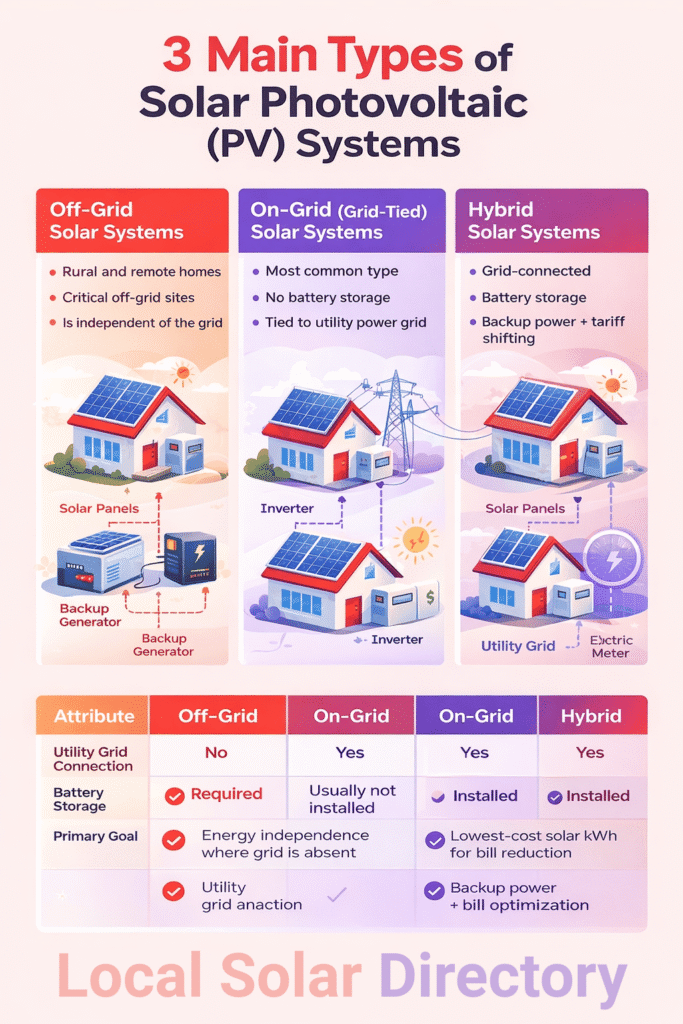
The table below compares system architecture, typical sizes, storage, and the most important engineering tradeoffs.
| Attribute | Off-Grid Solar System | On-Grid (Grid-Tied) Solar System | Hybrid Solar System |
|---|---|---|---|
| Utility grid connection | No | Yes | Yes |
| Battery storage | Required | Usually not installed | Installed |
| Backup power during a grid outage | Yes (system continues if sized correctly) | No (standard grid-tied inverters stop for safety) | Yes (for backed-up loads, if configured) |
| Typical residential PV size | ~2–15 kW DC (site + load dependent) | ~3–15 kW DC (bill offset design) | ~4–15 kW DC (offset + backup design) |
| Typical battery size | ~10–60 kWh (often 1–3 days of autonomy for critical loads) | 0 kWh | ~5–30 kWh (often 4–24 hours for critical loads) |
| Main energy losses beyond PV | Battery charge/discharge + generator losses (if used) | Minimal additional losses (no battery cycling) | Battery cycling losses when storing energy |
| Primary design goal | Energy independence where grid is absent | Lowest-cost solar kWh for bill reduction | Backup power + bill optimization (TOU, self-consumption) |
| Complexity | High | Moderate | High |
| Typical cost direction (relative) | Highest | Lowest | Medium–high |
What are the Off-Grid Solar Systems?
An off-grid solar system is a PV power system that operates without a utility-grid connection and uses battery storage (and often a generator) to supply electricity at night and during low-sun periods. Off-grid solar systems are used in locations where the electric grid is unavailable, unreliable, or uneconomical to extend.
- Remote homes and cabins (no utility service)
- Telecom and monitoring sites (cell towers, sensors)
- Agricultural and water pumping (with storage or direct-drive)
- Critical infrastructure in remote areas (clinics, ranger stations)
How an off-grid solar system works
Off-grid energy flow is a closed loop around storage:
- PV array produces DC power during daylight.
- Charge controller (often MPPT) regulates PV output and charges the battery safely.
- Battery bank supplies DC when PV is insufficient.
- Off-grid inverter converts DC to AC for household loads.
- Generator (optional) provides backup energy when solar resource is low for extended periods.
Core components
Off-grid system hardware is defined by storage and islanded operation.
- PV modules + mounting/racking
- Combiner box + DC protection (fuses/breakers, surge protection)
- MPPT charge controller (or DC-coupled inverter-charger, depending on design)
- Battery bank
- Lithium-ion (commonly LFP) or lead-acid (flooded/AGM/gel)
- Off-grid inverter or inverter-charger (forms the AC waveform)
- AC distribution panel + grounding and bonding
- Monitoring system (battery state-of-charge, PV yield, load tracking)
- Backup generator and transfer equipment (common in high-latitude or winter-peaking loads)
Typical sizes and practical sizing numbers
Off-grid sizing starts with daily energy (kWh/day) and peak power (kW), then adds autonomy and seasonal margin.
Typical residential ranges
- PV array: 2–15 kW DC
- Battery storage: 10–60 kWh usable (varies widely)
- Autonomy target: 1–3 days of critical-load coverage is common in residential designs
Simple sizing logic
- PV size depends on the “worst month” solar resource if the system is designed for year-round off-grid operation.
- Battery size depends on:
- critical loads (kWh/day)
- desired autonomy (days)
- usable depth of discharge (DoD)
Battery usable energy example (conceptual)
- Nominal battery: 20 kWh
- If usable DoD is 80% and round-trip is ~90%, usable delivered energy per cycle is ~20 × 0.80 × 0.90 ≈ 14.4 kWh.
Efficiency and energy losses
Off-grid PV “efficiency” is dominated by conversion and storage losses, not by the PV module alone.
- PV module efficiency (technology-dependent): commonly ~18–23% for modern monocrystalline modules under standard test conditions.
- Inverter conversion efficiency: typically mid-to-high 90% at rated power for quality inverters.
- Battery round-trip efficiency:
- Lithium-ion commonly ~90–95%
- Lead-acid commonly ~70–85% depending on operating conditions
- System-level delivered energy can be meaningfully lower than PV production because stored energy is cycled through the battery and inverter.
Costs: Off-grid solar costs rise because the system must provide reliability without the grid.
Main cost drivers are:
- Battery capacity (kWh) and battery replacement cycle
- Inverter-charger capacity (kW) sized for peak loads (wells, HVAC, workshops)
- Redundancy (generator integration, extra PV for winter, larger BOS)
- Installation complexity (remote logistics, trenching, custom electrical work)
In NREL benchmarking work across the 2010s–2020s, storage and balance-of-system hardware are consistently major drivers of residential system cost when batteries are added, even when module prices decline.
Battery storageis required. Battery storage is a defining feature of off-grid systems.
- Chemistry: LFP lithium-ion is common for safety and cycle life; lead-acid remains used in lower-cost or legacy setups.
- Depth of discharge (DoD): deeper cycling reduces life for many chemistries; lithium generally tolerates deeper cycling than lead-acid.
- Cycle life: varies with DoD, temperature, and charge rates; cycle life is a design constraint, not a fixed number.
Comparison to the next type: on-grid solar systems
Off-grid systems replace the grid with batteries and controls. On-grid systems use the grid as the balancing resource instead of a large battery bank.
- Off-grid: higher cost per delivered kWh because storage is required.
- On-grid: lower cost and simpler, because the grid absorbs surplus and supplies deficits.
What are the On-Grid (Grid-Tied) Solar Systems?
An on-grid solar system is a PV system that connects to the utility grid and typically operates without battery storage, using the grid to balance supply and demand.
Uses
On-grid solar is the most common configuration for residential and commercial buildings connected to utility service.
- Home electricity bill reduction through self-consumption and export credit mechanisms (net metering or net billing structures)
- Commercial load offset (daytime production matches daytime load in many facilities)
- Community and utility-scale PV also uses grid interconnection principles (different scale, similar concept)
How an on-grid solar system works
Grid-tied systems prioritize safe synchronization with utility power.
- PV array produces DC power during daylight.
- Grid-tied inverter converts DC to grid-synchronous AC.
- Building loads consume PV power first if local consumption exists at the moment.
- Excess PV exports to the grid through the service panel and meter (rules depend on local utility tariff).
- During a grid outage, standard grid-tied inverters stop producing power to prevent unintentional islanding, consistent with interconnection safety requirements (commonly aligned with IEEE 1547 family requirements and national electrical codes in many markets).
Core components
On-grid systems emphasize grid-interactive inverters and interconnection hardware.
- PV modules + racking
- Grid-tied inverter architecture
- String inverter, microinverters, or DC optimizers + string inverter
- DC and AC disconnects (as required by local code)
- Rapid shutdown equipment (jurisdiction-dependent, common in residential codes)
- AC service panel interconnection (breaker or supply-side connection)
- Revenue/utility metering + monitoring
Typical sizes and practical sizing numbers
On-grid systems are commonly sized to offset a portion of annual consumption.
- Typical residential PV size: 3–15 kW DC
- Typical annual energy yield per 1 kW DC:
- ~1,200–1,700 kWh/year in many populated regions (higher in high-irradiance locations, lower in cloudy/high-latitude locations)
- A practical starting point is to map annual household consumption (kWh/year) to PV size using local solar resource estimates (tools like NREL PVWatts use location-based irradiance and standard loss assumptions).
Efficiency and energy losses
On-grid systems avoid battery cycling losses, so delivered kWh per produced kWh is higher than in storage-heavy systems.
Common loss contributors:
- Inverter conversion (typically mid-to-high 90% efficiency at operating power)
- Soiling, mismatch, wiring, temperature effects, shading
- Clipping if DC array is oversized relative to inverter AC rating (intentional in many designs)
A widely used system metric is the performance ratio (PR), which often falls in the broad range of ~0.75–0.85 for well-designed systems depending on climate, temperature, and shading conditions. PR is not a universal constant; it is a site-dependent engineering outcome.
Cost drivers
On-grid systems tend to be the lowest-cost PV architecture because they omit storage.
Primary cost drivers:
- Labor and permitting/inspection (soft costs)
- Inverter choice (string vs microinverters)
- Roof complexity (pitch, material, multiple planes, shading)
- Electrical upgrades (main panel, service capacity, interconnection requirements)
NREL residential cost benchmark studies in the 2020s consistently show that non-module costs (inverter, racking, labor, permitting, overhead) are a large share of total installed cost for small-scale PV.
Battery storage: usually not installed
Battery storage is optional in grid-tied systems. When batteries are added for backup or tariff optimization, the system becomes a hybrid design in practical terms.
Comparison to the next type: hybrid solar systems
On-grid systems prioritize lowest cost and simplicity. Hybrid systems add batteries to provide backup power and time-shifting.
- On-grid: lowest complexity and usually lowest installed cost.
- Hybrid: higher cost and more components, but provides outage operation for backed-up loads.
What Are The Hybrid Solar Systems?
A hybrid solar system is a grid-connected PV system with battery storage that can operate in both grid-tied mode and islanded (backup) mode for selected loads.
Uses
Hybrid systems are deployed where either outage resilience or tariff structure makes storage valuable.
- Backup power for refrigeration, lighting, medical devices, network equipment, and selected HVAC
- Time-of-use (TOU) rate management by shifting solar energy to evening peak periods
- Self-consumption maximization where export credit is low compared to retail rates
- Power quality support for weak grids (voltage/frequency ride-through depends on inverter capabilities and grid rules)
How a hybrid solar system works
Hybrid systems manage multiple power paths: PV, battery, loads, and grid.
- PV supplies loads directly when production matches demand.
- PV charges the battery when there is surplus.
- Battery discharges to loads when PV is low or when tariffs favor battery use.
- Grid supplies loads when PV and battery are insufficient.
- During an outage, the hybrid inverter isolates from the grid and forms a local AC microgrid for backed-up circuits (often via a critical loads panel).
Core components
Hybrid systems combine the grid hardware of on-grid PV with the storage hardware of off-grid PV.
- PV modules + racking
- Hybrid inverter (multi-mode) or inverter-charger
- Provides grid-interactive operation and islanding capability
- Battery pack + battery management system (BMS)
- Commonly lithium-ion (LFP or NMC in residential products)
- Critical loads subpanel (backed-up circuits)
- Current transformers / smart meter for export control and energy management
- Protection equipment (disconnects, breakers, surge protection)
- Optional generator input (some hybrid inverters support generator integration)
Typical sizes and practical sizing numbers
Hybrid sizing is usually driven by critical load backup plus bill offset goals.
- Typical residential PV size: 4–15 kW DC
- Typical battery size: 5–30 kWh
- Common backup design targets:
- 4–12 hours for essential circuits in many suburban designs
- >24 hours for homes with frequent outages and conservative critical load selection
A practical approach is to list critical loads (kW) and target backup duration (hours), then size battery usable capacity accordingly.
Efficiency and energy losses
Hybrid efficiency depends on how much energy is routed through the battery.
- Direct PV-to-load or PV-to-grid paths avoid storage losses.
- Stored energy incurs:
- battery round-trip losses (often ~85–95% for lithium systems)
- inverter conversion losses during charge and discharge
- The more frequently the battery cycles, the more total system losses resemble off-grid operation for that portion of energy.
Cost drivers
Hybrid systems cost more than on-grid PV because of storage and more advanced power electronics.
Main cost drivers:
- Battery capacity (kWh) and product class (backup-capable vs non-backup)
- Hybrid inverter and required transfer/isolation hardware
- Electrical rework for a critical loads panel
- Controls and commissioning (export limiting, TOU modes, backup configuration)
Battery storage: installed
Battery storage is a defining feature of hybrid systems.
Design parameters that materially affect results:
- Usable battery capacity (nominal kWh × usable DoD)
- Continuous and surge power rating (kW) for starting motors
- Thermal environment (temperature affects available capacity and cycle life)
- Cycling strategy (backup-only vs daily TOU cycling)
Comparison to the first type: off-grid solar systems
Hybrid systems and off-grid systems both use batteries, but the grid changes the engineering requirements.
- Hybrid: grid connection reduces required battery autonomy and generator dependence.
- Off-grid: battery autonomy and seasonal resource dominate the design, because the grid is not available as a balancing resource.
- Hybrid: typically smaller battery banks than off-grid for the same home, because the grid covers long deficits.
What are the types of solar panels?
The main types of solar panels are monocrystalline silicon, polycrystalline silicon, and thin-film panels (including CdTe, CIGS, and amorphous silicon), plus newer high-efficiency variants such as TOPCon, HJT, and bifacial modules built on crystalline silicon platforms.
Solar panel types by cell technology
- Monocrystalline silicon (mono-Si)
High module efficiency and high power density. Typical modern module efficiencies often fall in the high teens to low 20% range depending on product generation. - Polycrystalline silicon (multi-Si)
Lower efficiency than mono on average, historically lower cost. Less common in premium residential markets as mono pricing converged. - Thin-film
Includes cadmium telluride (CdTe), copper indium gallium selenide (CIGS), and amorphous silicon (a‑Si). Thin-film can have different temperature coefficients and low-light behavior than crystalline silicon. - Bifacial crystalline silicon
Generates from the front and rear. Bifacial gain depends on ground reflectance (albedo) and mounting geometry; gains of single-digit to ~20% are reported in field deployments when site conditions are favorable. - Building-integrated PV (BIPV)
PV integrated into roofing, façades, or glazing. BIPV is an application format, often using crystalline silicon cells.
Typical attributes that differentiate panel types
The table below summarizes practical engineering attributes used in panel selection.
| Panel type | Typical efficiency trend | Temperature behavior | Common use cases | Notable constraints |
|---|---|---|---|---|
| Monocrystalline silicon | Higher | Moderate temperature coefficient | Residential rooftops, commercial | Higher power density can increase roof utilization |
| Polycrystalline silicon | Lower (relative) | Similar to mono | Cost-focused installations | Less common in newer premium product lines |
| Thin-film (CdTe/CIGS/a‑Si) | Lower–mid (varies by subtype) | Often favorable coefficients | Utility-scale, large roofs | Area requirements increase for same kW |
| Bifacial crystalline | Similar front efficiency + rear gain | Similar to mono | Ground-mount, carports | Needs reflective surfaces and clearance |
Reliability and degradation numbers used in design
- PV modules are commonly sold with 25–30 year power warranties.
- A well-cited NREL analytical review by Jordan and Kurtz (2013) reported median degradation rates for many fielded PV systems around ~0.5% per year, with wide variation by climate, installation quality, and technology generation. Degradation rate directly affects long-term energy yield and is more decision-relevant than nameplate wattage alone.
Panel type vs PV system type
Solar panel type does not determine whether a system is off-grid, on-grid, or hybrid.
- Off-grid, on-grid, and hybrid systems can all use monocrystalline, polycrystalline, or thin-film modules.
- System type is primarily an architecture decision about grid interconnection and storage.
Which type is best for my home?
The best solar PV system type for a home is on-grid when the utility grid is available and reliable, hybrid when backup power or time-shifting value is high, and off-grid when the home has no practical grid access.
Decision rules based on measurable home conditions
Use these conditions as a technical filter.
- Grid access
- Choose off-grid if the home is not connected to a utility grid or grid extension cost is prohibitive.
- Choose on-grid or hybrid if the home has grid service.
- Outage frequency and outage cost
- Choose hybrid if outages are frequent enough that lost refrigeration, medical-device power, heating controls, or remote-work disruption has a measurable cost.
- Choose on-grid if outages are rare and backup power is not a requirement.
- Electricity tariff structure
- Choose hybrid if the utility uses time-of-use pricing and evening prices are materially higher than midday prices, or if export credits are low compared to retail purchase rates.
- Choose on-grid if export crediting is strong and battery time-shifting has limited additional value.
Home system sizing numbers that map to each system type
These sizing values are common starting points in residential design discussions.
PV array sizing (all system types)
- PV size is typically derived from annual consumption:
- Many locations produce ~1,200–1,700 kWh/year per 1 kW DC installed.
- Example: 9,600 kWh/year ÷ 1,400 ≈ 6.9 kW DC (location-dependent).
Battery sizing (hybrid and off-grid)
- Battery capacity is derived from critical loads and backup duration:
- Critical load energy (kWh) = average critical load (kW) × hours.
- Usable battery energy is reduced by DoD limits and round-trip efficiency.
Scenario matrix for homes
This table maps common residential constraints to system type selection.
| Home condition | On-Grid | Hybrid | Off-Grid |
|---|---|---|---|
| Utility grid available | ✅ | ✅ | ❌ |
| Home needs backup power | ❌ (standard configuration) | ✅ | ✅ |
| Lowest installed cost priority | ✅ | ❌ | ❌ |
| Frequent outages | ⚠️ | ✅ | ✅ |
| TOU rates / low export credit | ⚠️ | ✅ | ✅ (if no grid) |
| Remote location | ❌ | ⚠️ | ✅ |
| High critical-load autonomy requirement (days) | ❌ | ⚠️ (possible but expensive) | ✅ |
Practical checklist to choose a system type
Use these measurable inputs before selecting equipment:
- Collect 12 months of kWh usage from utility bills (or generator fuel records for remote homes).
- List critical loads in watts and required hours (refrigeration, medical devices, well pump, heating controls).
- Quantify outage frequency (events/year, average duration).
- Confirm tariff terms (export credit rules, TOU windows, demand charges if applicable).
- Measure usable roof area and shading profile (roof planes, azimuth, tilt, obstructions).
A system type decision becomes straightforward after those five inputs are quantified.
