

Solar thermal turns sunlight into heat for water, air, or industrial fluids. Solar PV turns sunlight into electricity for lights, appliances, and the grid. That single difference decides nearly everything else: hardware, efficiency numbers, costs, storage, and best uses. (Heat warms showers. Electricity runs laptops. Laptops make terrible showers.)
What is the main difference between solar thermal and solar photovoltaic (PV) energy?
The main difference between solar thermal and solar photovoltaic (PV) energy is thier working principles, Components, Efficiency, and cost. see the difference table.
1) Working principle
Solar thermal (heat first):
- Sunlight hits a dark absorber surface.
- The absorber raises the temperature of a working fluid (water, glycol mix, or air).
- Heat moves through a heat exchanger into a storage tank or building loop.
- Control logic keeps flow where heat gain is positive.
Solar PV (electricity first):
- Photons hit a semiconductor junction and create charge carriers (photovoltaic effect).
- A module outputs DC electricity.
- An inverter converts DC to AC for home loads or grid export.
- Monitoring and protection gear manage safety and performance.
A key practical point: heat systems fight heat loss (pipes, tanks, night cooling). PV systems fight electrical loss (inverter conversion, wiring, mismatch, shade).
2) Components
Solar thermal components (typical home hot water):
- Collector: glazed flat plate, evacuated tube, or unglazed (pool)
- Pump or thermosyphon flow path
- Heat-transfer fluid (direct water or indirect glycol loop)
- Heat exchanger (often inside the tank)
- Insulated storage tank
- Expansion tank, valves, pressure relief, air vent
- Controller, sensors
- Freeze and overheat protection strategy
Solar PV components (typical grid-tied home system):
- PV modules and racking
- Inverter (string, microinverters, or DC optimizers plus string inverter)
- Combiner/disconnects, breakers, grounding, rapid shutdown
- Production meter, monitoring
- Optional battery, battery inverter, critical-load panel
3) Efficiency
PV efficiency (electric conversion):
Fraunhofer ISE reports commercial mono-Si module efficiency rising from about 16% to values above 22% across roughly the last decade, with lab records higher.
Solar thermal efficiency (heat capture):
Solar thermal collector testing typically reports a “zero-loss” optical efficiency and heat-loss coefficients, then predicts efficiency at each operating temperature. One SRCC OG-100 certificate (SunEarth TRB-26) shows a simplified optical efficiency near 0.737 with heat-loss terms that reduce output as the collector runs hotter than ambient.
A fast rule that stays honest:
- PV efficiency answers: “How much sunlight becomes electricity at the module?”
- Thermal efficiency answers: “How much sunlight becomes usable heat at a chosen temperature?”
Electricity is “high grade” energy; heat quality depends on temperature. That is why PV looks lower in percent, yet feels more universal in daily life.
4) Cost and cost units (where comparisons often go wrong)
PV and thermal often get priced in different units:
- PV: $/Wdc installed, plus the long-run $/kWh electricity (LCOE for utility projects)
- Thermal: cost per system (collector + tank + plumbing) or per m² of collector area, then $/kWh-thermal delivered
For PV in the United States, NREL’s Q1 2023 benchmark gives an 8 kWdc residential PV modeled market price of about $2.68/Wdc (cash cost benchmark method). NREL notes reported market prices often run higher due to customer-specific features and business models.
For utility-scale PV worldwide, IRENA reports a global weighted-average LCOE for newly commissioned utility PV in 2023 of USD 0.044/kWh, with a global weighted-average installed cost of USD 758/kW cited in the same executive summary.
For solar water heating, the U.S. Department of Energy states that water-heating bills commonly drop 50% to 80% after installation, and it defines key metrics such as solar energy factor (often 2 or 3) and typical solar fraction (about 0.5 to 0.75).
5) Big comparison table (what differs and why it matters)
This table compares the same categories side by side, using the units each technology uses in practice.
| Topic | Solar thermal (heat) | Solar PV (electric) | What it means in practice |
|---|---|---|---|
| Primary output | Heat (hot water, warm air, process heat) | Electricity (AC after inverter) | Match the system to the load you pay for most |
| Main physics | Absorption + heat transfer | Semiconductor conversion | Thermal cares about insulation; PV cares about shade and wiring |
| Typical home “best fit” | Domestic hot water, pool heating, some space heating support | Whole-home electric loads, EVs, heat pumps, export to grid | PV fits more end uses; thermal can hit hot-water bills hard |
| Efficiency metric | Collector efficiency curve vs temperature difference | Module efficiency, performance ratio, inverter efficiency | Do not compare one “percent” to another without defining output quality |
| Storage | Hot water tank, thermal mass, phase-change, seasonal storage in some designs | Batteries, net metering, load shifting | Heat storage is cheap per kWh; electric storage costs more per kWh |
| Plumbing and maintenance | Pumps, valves, glycol checks, scale control, stagnation management | Mostly electrical checks, inverter replacement risk | Thermal demands more routine mechanical care |
| Freeze risk | Relevant for wet collectors in cold climates | None for panels | Cold regions push thermal toward glycol loops and correct design |
| Overheat risk | Collector stagnation temperatures can get high | Module heat mainly reduces output | Thermal needs dump loads, control logic, or design to avoid boiling |
| Space/roof use | Often fewer m² for hot-water target, but thicker hardware | Modular panels, simple mounting | Roof geometry and shading decide PV output more sharply |
| Typical cost language | “System cost” plus delivered kWh-thermal | $/Wdc plus delivered kWh-electric | Compare payback only after converting to the same bill savings unit |
| Typical degradation | Collector glazing seals, fluid quality, pump wear | PV degradation often under 1% per year in field literature | PV output declines slowly; thermal failures often come from balance-of-system parts |
| End-of-life recycling | Metals, glass, fluids | Glass, aluminum, silicon, encapsulants | Both have recycling pathways, PV recycling infrastructure is expanding in many regions |
PV degradation literature from NREL and related reviews often reports median module degradation near the 0.5% per year range for crystalline silicon fleets, with system losses affected by soiling and balance-of-system factors.
6) Efficiency details with real coefficients (thermal) vs real module numbers (PV)
Before the table below: thermal collectors get rated with “intercept” and loss coefficients. Those numbers let you estimate efficiency at a given inlet temperature, ambient temperature, and irradiance.
| Example rating item (solar thermal) | What it means | One certified example value |
|---|---|---|
| Optical efficiency (zero-loss) | Theoretical efficiency when collector temperature equals ambient | ~0.737 |
| First-order loss coefficient (a1) | Heat loss rises as collector runs hotter than air | ~3.678 W/m²·°C |
| Second-order loss term (a2) | Extra loss curvature at higher temperature differences | ~0.007 (as shown on certificate) |
For PV, a comparable “real world” anchor point is commercial module efficiency. Fraunhofer ISE reports commercial mono-Si modules now exceeding 22% in market products, with lab records higher.
7) Pros and cons (kept factual)
Solar thermal strengths:
- High useful energy per roof area for low-to-moderate temperature heat loads
- Heat storage in insulated tanks costs relatively little per kWh-thermal
- Direct bill impact when hot water is a large household expense
Solar thermal limits:
- More parts that wear: pumps, valves, sensors
- Design must address freezing, scaling, corrosion, stagnation
- Heat has fewer end uses than electricity inside most homes
Solar PV strengths:
- One system supports many loads: lights, refrigeration, electronics, EV charging
- Modular expansion: add panels later if roof and inverter allow
- Mature standards for safety and interconnection
Solar PV limits:
- Battery storage adds cost and complexity
- Shading and roof constraints reduce output sharply
- Inverters are a common mid-life replacement item
8) Applications (where each wins cleanly)
Solar thermal applications:
- Domestic hot water
- Pool heating (unglazed collectors)
- Space-heating support via hydronic loops (climate dependent)
- Industrial process heat at low temperatures (food, textiles, washing lines)
- Solar air heating for ventilation preheat (warehouses, some commercial buildings)
Solar PV applications:
- Home electricity and grid export
- Behind-the-meter peak shaving with batteries
- EV charging
- Remote power (with batteries or hybrid generators)
- Utility-scale generation
What are the similarities between solar thermal and solar photovoltaic (PV) energy?
Both systems share the same starting point and many of the same “real world” constraints.
- Both depend on local solar resource, roof orientation, tilt, and shading patterns.
- Both benefit from good installation quality, good sealing, and code compliance.
- Both face output drops from dirt and poor maintenance (dust on glass, blocked airflow, failed sensors).
- Both use published test standards and performance ratings (PV module standards; solar thermal collector standards such as ISO 9806 frameworks referenced by collector certification programs).
- Both often pair well with demand reduction first: insulation, low-flow fixtures, efficient appliances.
Before the quick comparison table below: this is the “shared checklist” view, focusing on site and installation rather than physics.
| Shared factor | What it affects |
|---|---|
| Solar access (shade, horizon line) | Annual energy yield |
| Roof condition and structure | Safety, longevity, leak prevention |
| Local codes and permits | Equipment choice, wiring/plumbing routes |
| Installer skill | Hidden losses and failures more than the technology choice |
| Maintenance habits | Dirt, corrosion, loose connections, sensor drift |
How do you choose between solar thermal and solar PV for your home installation?
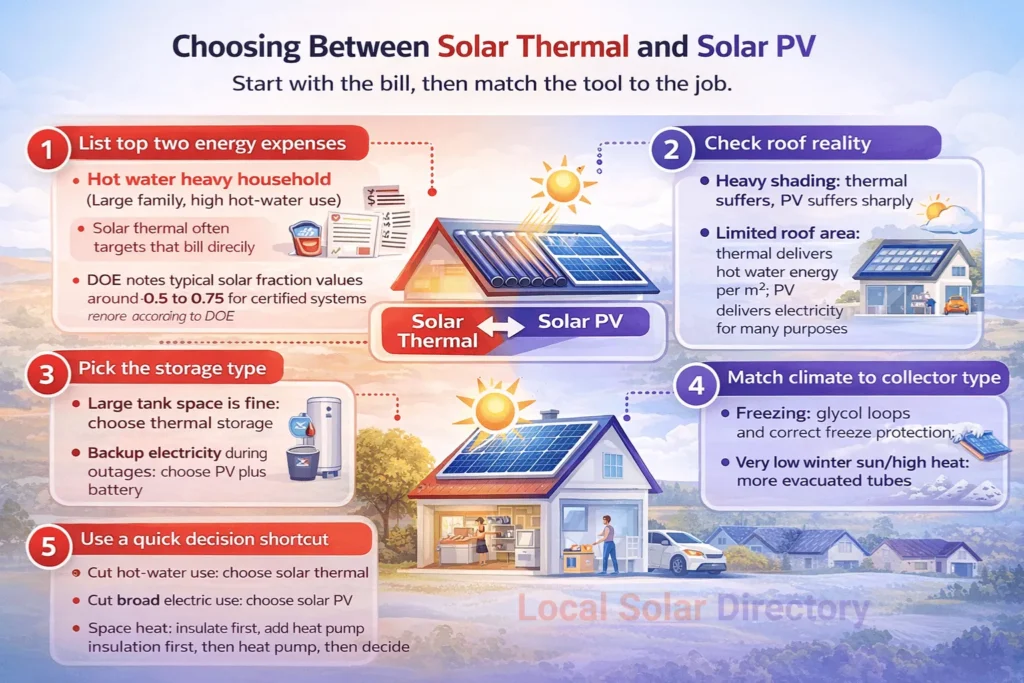
You choose solar thermal or solar PV for your home installation is Start with the bill, then match the tool to the job.
- List the top two energy expenses.
- Hot water heavy household (large family, high hot-water use): solar thermal often targets that bill directly. DOE notes typical solar fraction values around 0.5 to 0.75 for certified systems, which means a large share of annual water heating load may come from the sun.
- Electric-heavy household (AC, appliances, EV): PV usually fits best.
- Check roof reality.
- Heavy shading: thermal still suffers, PV suffers more sharply because partial shade can limit string output unless module-level electronics exist.
- Limited roof area: thermal may deliver more hot-water energy per m² for that one purpose; PV delivers electricity for many purposes.
- Pick the storage type you actually want to live with.
- If hot water tank space is fine: thermal storage is simple.
- If backup electricity during outages matters: PV plus battery fits that goal.
- Match climate to collector type.
- Freezing climates push thermal toward indirect glycol loops and correct freeze protection. DOE describes indirect circulation systems that use non-freezing heat-transfer fluid for freeze-prone climates.
- Very low winter sun angles and high temperature lift raise thermal losses; evacuated tubes often handle higher temperature differences better, at higher equipment cost. A UK government buyer guide notes evacuated tubes tend to cost more than glazed flat plates and gives typical annual yield figures for evacuated tube collectors.
- Use a simple decision shortcut (if time is short).
- Goal: cut hot-water fuel use fast with tank storage: choose solar thermal.
- Goal: cut broad electric use and prepare for electrification: choose solar PV.
- Goal: space heating: compare three options in order: insulation first, then heat pump, then decide whether PV or thermal supports the heat pump plan.
How does a solar thermal collector outperform a solar PV panel for its intended purpose?
For making heat, solar thermal often produces more usable heat per square meter than PV makes electricity per square meter, then turned into heat.
A clean way to see it is to compare “heat per m² at noon” using typical certified-style numbers:
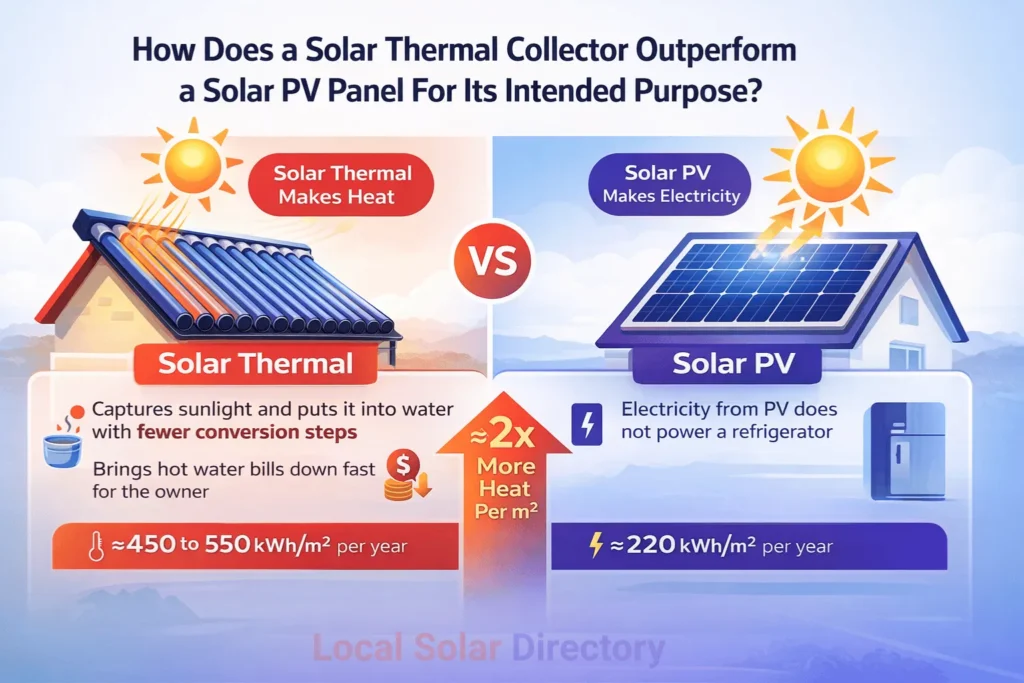
- PV: commercial modules exceed ~22% efficiency in today’s market products per Fraunhofer ISE’s report summary. A 1000 W/m² sun on 1 m² yields about 220 W of DC power at the module before system losses.
- Solar thermal: a certified glazed collector can show a zero-loss efficiency near 0.74, then loses efficiency as operating temperature rises above ambient. At modest temperature lift, thermal output often stays far above PV’s electric output on the same area.
What that means in plain terms:
- If the job is hot water at moderate temperature, thermal captures sunlight and puts it into water with fewer conversion steps.
- If the job is electricity, PV wins because heat does not power a refrigerator.
One more practical comparison uses annual yield figures. A UK government purchaser guide states an evacuated tube collector collects about 450 to 550 kWh/m² per year, and a typical 4 m² system delivers about 2,200 kWh per year of solar heat.
A fair caution: PV paired with a heat pump changes the math because a heat pump moves heat with a coefficient of performance often above 2 in many operating conditions. In that setup, PV electricity can translate into several units of delivered heat per unit of electric input, narrowing the gap for space and water heating. The right comparison then becomes: thermal system vs PV plus heat pump, not thermal vs PV plus resistance heater.
The bill result matters more than the physics trophy. DOE reports that, on average, solar water heater installations reduce water heating bills by 50% to 80%, which is the score most homeowners care about.
