

Solar thermal energy is one of the oldest tricks in the human tool kit: sunlight warms a surface, and the heat does useful work.
What is the Solar Thermal Energy?
Solar thermal energy is heat produced when a collector absorbs sunlight and transfers that heat to a working fluid such as water, air, glycol, thermal oil, or molten salt.
Solar thermal energy is used as heat at the point of use (hot water, space heat, industrial heat) or as heat that later drives a turbine for electricity in solar thermal power plants.
A short note from the past: solar heat for cooking and hot water shows up long before modern grids, from early solar cookers (18th century) to commercial solar water heaters in the late 19th century.
How does it work?
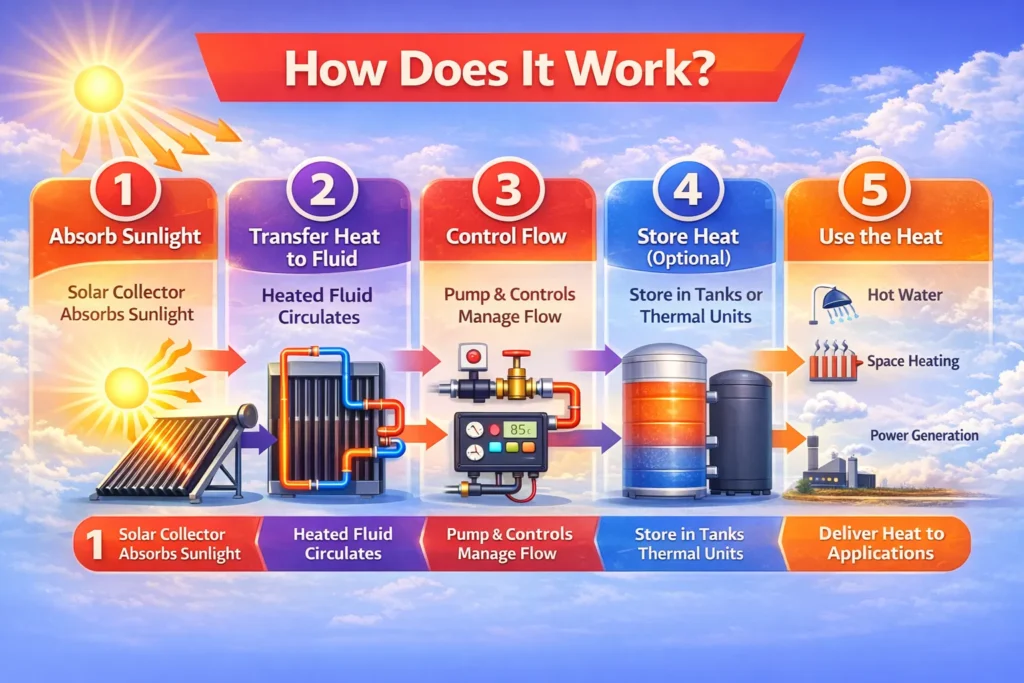
Solar thermal energy works by absorbing solar radiation on an absorber surface, moving the heat into a fluid, and delivering that heat at a chosen temperature.
Working sequence (plain and practical):
- Absorb sunlight: A dark absorber or receiver takes in solar radiation (this is the “solar energy absorption” step).
- Move heat into a fluid: Tubes or channels pass the heat into water, glycol mix, air, thermal oil, or molten salt.
- Control flow: Passive circulation uses natural buoyancy; active circulation uses pumps and controls.
- Store heat (optional): Storage uses hot water tanks, large seasonal stores, or high-temperature tanks for CSP.
- Use heat: Heat goes to taps, radiators, air handlers, industrial heat exchangers, absorption chillers, or a steam generator for power.
What are the types of Solar Thermal Energy?
Types of solar thermal energy are grouped by temperature level and collector design, since temperature decides the job the heat can do.
The next table lists common collector types, typical temperature ranges, and where each type fits best.
| Type (by collector) | Typical outlet temperature | Common uses | Notes |
|---|---|---|---|
| Unglazed polymer collectors (low-temp) | ~20°C to 40°C | Pool heating, low-temp water preheat | Low cost, high output when temperature lift stays small |
| Glazed flat-plate collectors (mid-temp) | ~40°C to 80°C | Domestic hot water, space heating support | Widely used; steady performance in many climates |
| Evacuated-tube collectors (mid to high) | ~60°C to 120°C (higher in good sun) | Hot water, space heating, some process heat | Better at higher temperature lift due to reduced convective loss |
| Concentrating collectors (CST) | ~150°C to 400°C+ | Industrial process steam, high-temp heat | Uses mirrors or lenses to raise temperature |
| Concentrating solar power (CSP) fields | ~290°C to 565°C (typical molten-salt tower loop) | Electricity generation with thermal storage | Two-tank molten salt designs often run near 290°C “cold” and 565°C “hot” |
Where is Solar Thermal Energy used?
Solar thermal energy is used wherever heat demand exists, especially where heat demand is steady and storage is simple.
Common uses (from small to large):
- Domestic hot water: Solar water heaters cut water-heating bills by a large fraction in many homes when systems are sized and sited well.
- Space heating: Active solar heating supports hydronic floors, radiators, and air handlers, often paired with a backup boiler or heat pump.
- Pools: Unglazed pool collectors deliver large amounts of low-temperature heat at low cost.
- District heating: Large collector fields feed town-scale networks; published case data shows high annual yields per square meter in operating plants.
- Industrial process heat: Solar concentrators supply steam or hot oil for processes where temperatures sit in the 150°C to 400°C range.
- Cooling: Absorption chillers run on heat, so solar heat supports cooling loads in sunny seasons.
- Electricity: Solar thermal power plants concentrate sunlight, generate steam, and drive turbines and generators.
What are the advantages and disadvantages of Solar Thermal Energy?
Advantages of solar thermal energy center on high solar-to-heat conversion and low-cost thermal storage, especially for hot water and district heat.
Disadvantages of solar thermal energy center on site constraints, temperature limits for non-concentrating collectors, and maintenance of plumbing and heat-transfer fluids.
Advantages
- Heat output per area fits heat loads well: District-heating literature reports that solar thermal collector fields can deliver several times more usable heat per area than PV-to-heat in certain district-heating contexts.
- Storage is cheaper than electrical batteries for many heat uses: Hot water tanks and seasonal stores rely on common materials (water, soil, insulation).
- Simple end-use: Heat for washing, bathing, cleaning, and process hot water does not require converting to electricity first.
- Mature technology: Solar water heating has long commercial history, with strong documentation of early deployment and long service life in early systems.
Disadvantages
- Heat is harder to move than electricity: Heat transport needs insulated pipes, pumps, and heat exchangers, which adds cost and losses.
- Freezing and overheating risks: Cold climates push systems toward glycol loops and freeze protection; stagnation management matters in hot sun.
- Higher temperatures raise complexity: Industrial heat and power require concentrating optics, tracking, and high-temperature fluids.
- Water use for some power-plant cooling designs: Thermal power cycles often use cooling; dry cooling reduces water use but raises cost and reduces output in hot weather.
What is concentrated solar thermal?
Concentrated solar thermal is a solar thermal approach that uses mirrors or lenses and tracking to focus sunlight onto a receiver, producing higher temperatures than flat-plate or evacuated-tube collectors.
What is the difference between Solar Thermal Energy & concentrated solar power?
Difference between solar thermal energy and concentrated solar power is the output goal: solar thermal energy delivers heat, while concentrated solar power (CSP) delivers electricity by running a heat engine.
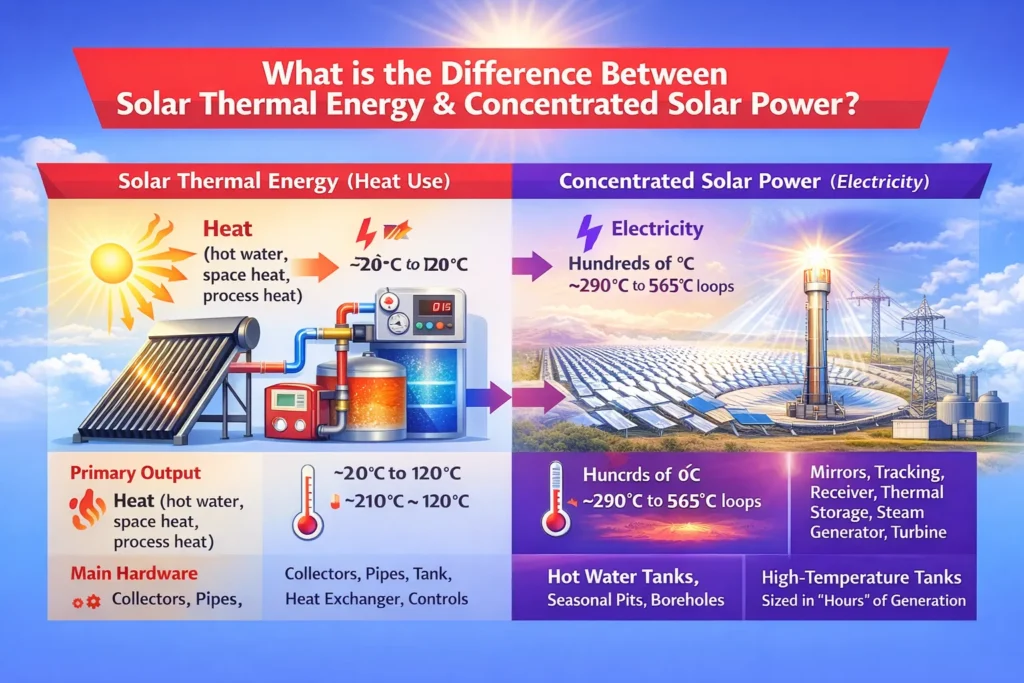
The next table compares the two in the way engineers usually separate them: output, temperature, equipment, and storage.
| Topic | Solar Thermal Energy (heat use) | Concentrated Solar Power (electricity) |
|---|---|---|
| Primary output | Heat (hot water, space heat, process heat) | Electricity via turbine-generator |
| Typical temperature | ~20°C to 120°C for most building systems | Hundreds of °C; molten-salt towers often cite ~290°C to 565°C loops |
| Main hardware | Collectors, pipes, tank, heat exchanger, controls | Mirrors, tracking, receiver, thermal storage, steam generator, turbine |
| Storage style | Hot water tanks, seasonal pits, boreholes | High-temperature tanks (often molten salt) sized in “hours” of generation |
| Best fit | Buildings, district heat, many industrial heat needs | Utility-scale grids where dispatchable solar power has value |
What is the difference between Solar Thermal Energy & Photovoltaic (PV) Solar energy?
Difference between solar thermal energy and photovoltaic (PV) solar energy is the conversion method: solar thermal converts sunlight to heat, while PV converts sunlight to electricity in semiconductor cells.
The next table focuses on practical differences that affect design and cost: output type, efficiency style, storage, and best uses.
| Topic | Solar Thermal Energy | Photovoltaic (PV) |
|---|---|---|
| Output | Heat | Electricity |
| Where efficiency matters | High solar-to-heat conversion helps when heat demand is local | Module conversion efficiency matters for area-limited roofs; commercial mono-crystalline module efficiency rose from ~16% to 22%+ over the last decade (reported by Fraunhofer ISE). |
| Storage | Thermal storage is straightforward (hot water, seasonal pits) | Storage is electrical (batteries) or grid export/import |
| Best match | Hot water, district heat, some process heat | Lights, motors, electronics, grid supply |
What are the cost to setup Solar Thermal Energy?
Cost to set up solar thermal energy depends on temperature, scale, and storage size, so costs are best stated by application type rather than a single number.
The next table gives published cost ranges for common setups, using government and program reports where available.
| Setup type | Typical scale | Reported cost ranges (installed) | Source notes |
|---|---|---|---|
| Solar pool heating (unglazed) | Home pool | About $50 per ft² of collector area | DOE Energy Saver estimate |
| Solar domestic hot water (flat plate, active) | Home | About $100 per ft² (about $1,000 per m²) of collector area; example system about $4,000 | DOE Energy Saver estimate and example |
| Solar domestic hot water (evacuated tube) | Home | About $424 per ft² of collector area in one DOE example set | DOE Energy Saver estimate |
| District heating collector fields | Multi-megawatt thermal | Collector-field investment reported around 320 to 700 EUR per m² (example range for ~10,000 m² fields) | IEA SHC Task 68 report |
| District heating plant example | 110 MW thermal | Example investment about EUR 35 million for a 110 MW plant; published LCOH range 18 to 33 EUR per MWh over 25 years | IEA SHC Task 68 fact sheet |
| CSP (electricity) | Utility | Costs vary by design and storage hours; NREL ATB reports costs in 2022 dollars and ties them to SAM component estimates | NREL ATB documentation |
Two cost notes that keep budgets honest:
- Collector area is not the full project cost. Tanks, heat exchangers, pumps, controls, valves, insulation, and labor add heavily at higher temperatures.
- Fuel price drives value. DOE lists the key savings drivers as hot-water use, system performance, local solar resource, incentives, and local fuel prices.
what are the storage options for solar thermal energy ?
Storage options for solar thermal energy fall into short-term storage (hours to days) and long-term storage (weeks to seasons), with special high-temperature storage for CSP.
The next table lists the main storage options and where each one fits.
| Storage option | Temperature range | Typical use | Published sizing examples |
|---|---|---|---|
| Domestic hot water tank | ~40°C to 80°C | Daily hot water smoothing | Standard in most solar water heaters |
| Buffer tank for heating loops | ~30°C to 60°C+ | Space heating support | Common in hydronic systems |
| Seasonal pit thermal energy storage (PTES) | ~40°C to 95°C+ | District heating seasonal shifting | IEA SHC Task 68 reports daily storage around 50 to 100 liters per m² collector for 10% to 20% solar share; seasonal coverage targets push storage above 200 liters per m² collector. |
| Large PTES loss rates | District-scale | Seasonal district heat | Example PTES larger than 50,000 m³ reported around 10% annual storage losses; one 62,000 m³ system reported about 8% annual losses. |
| Two-tank molten salt (CSP) | ~290°C to 565°C (typical tower loop) | Dispatchable electricity (hours after sunset) | Classic molten-salt tower description cites ~290°C “cold” and ~565°C “hot”. |
| Phase-change materials (PCM) | Application-set | Compact storage near set temperature | Described in DOE thermal storage references as latent storage based on phase change |
| Thermochemical storage | High-temp R&D | Very high energy density | Active research topic in CSP pathways |
What is solar thermal Power Plant ?
Solar thermal power plant is a power station that collects and concentrates sunlight to heat a fluid, produces steam, and drives a turbine connected to a generator.
Solar thermal power plant designs usually use one of four optical families: parabolic trough, power tower, dish, or linear Fresnel.
Is solar thermal energy system installation Worth It?
Solar thermal energy system installation is worth it when measured savings over system life exceed installed cost, maintenance, and financing, and published guidance points to the strongest cases.
Decision facts that tie directly to dollars:
- Bill impact: DOE reports average water-heating bill reductions of 50% to 80% after solar water heater installation.
- Installed cost and break-even: NREL (Cassard, Denholm, Ong, 2011) calculated break-even installed cost ranges that vary widely by location, backup fuel, and incentives, spanning from under a few thousand dollars to over ten thousand dollars in some modeled cases.
- Maintenance reality: DOE notes passive systems have low upkeep; glycol-based freeze-protection fluids degrade and commonly need change every 3 to 5 years.
- Best fits: High hot-water demand, high local conventional fuel prices, good solar access, and straightforward roof plumbing consistently show up as the high-savings conditions in DOE guidance.
Is solar energy different from solar thermal energy?
Solar energy is different from solar thermal energy because solar energy is the umbrella term for energy from the sun, while solar thermal energy is the heat portion that comes from sunlight absorption in collectors or receivers.
