

Top 12 Solar PV System Companies in the World
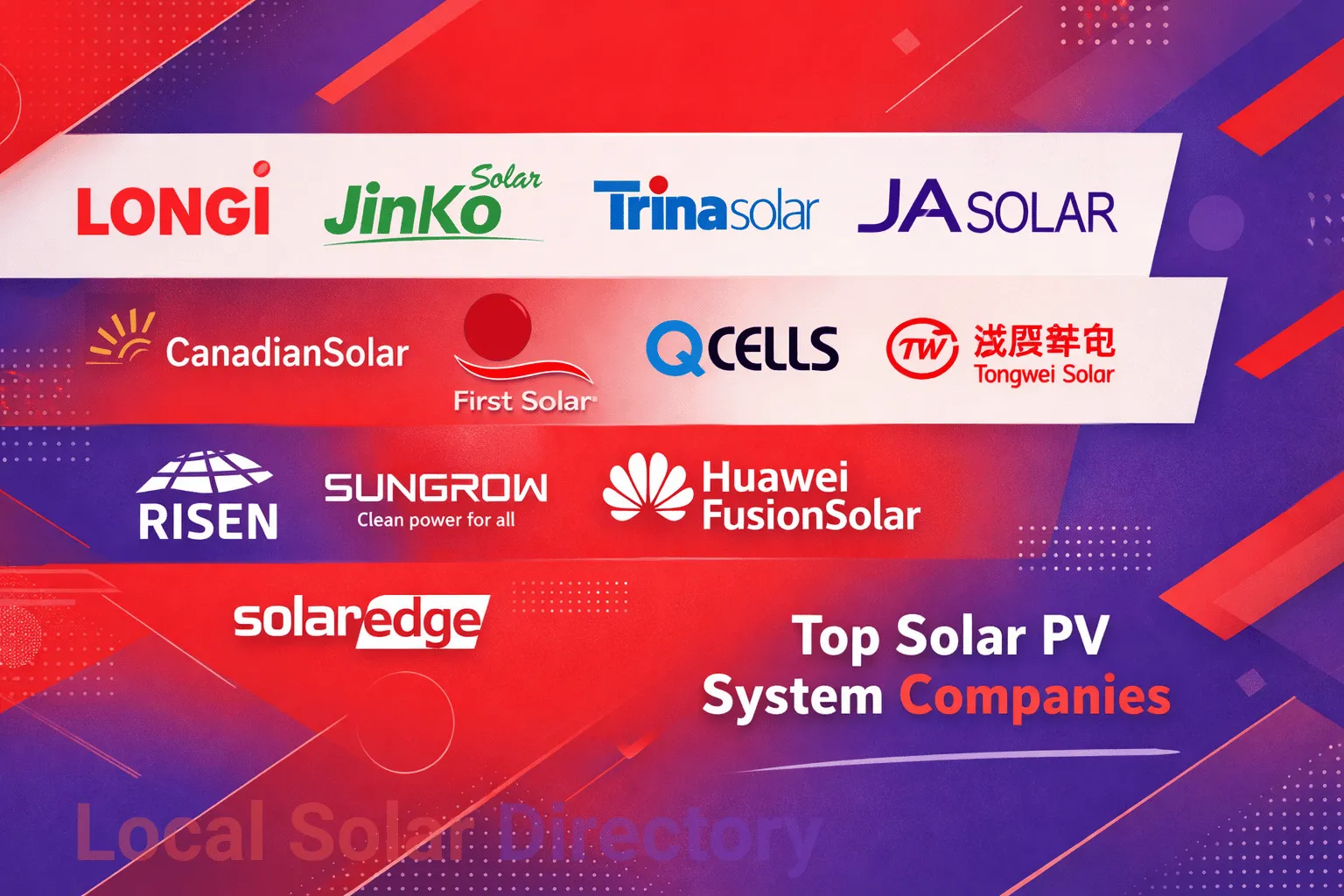
A modern solar PV system is built from 3 main layers: (1) PV modules, (2) inverters (and sometimes batteries), and (3) “balance of system” (BOS) parts like racking, wiring, switches, and services needed to make the system operational.
Because our website is a solar installer companies directory, this list focuses on global PV brands that installers and EPCs commonly source for modules and power electronics. The # numbers are for easy scanning, not a strict “best-to-worst” ranking. For context, 2024 shipment rankings for PV modules commonly include brands like JinkoSolar, JA Solar, LONGi, Canadian Solar, and Trina Solar among the leading shippers.
1) LONGi Green Energy Technology (LONGi)
LONGi was founded in 2000 and lists a corporate address in Xi’an, Shaanxi, China. LONGi positions itself as a solar technology company developing PV solutions for large-scale power plants, industries, and households, so installers typically encounter LONGi as a high-volume module brand with market-specific certifications and models.
2) JinkoSolar
JinkoSolar was founded in 2006 and is headquartered in Shanghai, China. On its global presence page, JinkoSolar reports 14+ global factories, 25+ logistic centers, 35+ service centers, and coverage in 160+ countries, which is a practical signal of broad distribution and after-sales infrastructure.
3) Trina Solar
Trina Solar was founded in 1997 and is headquartered in Changzhou, China. The company states it operates across PV products, energy storage, system solutions, and digital energy services, so Trina-branded equipment can show up in both rooftop and utility-scale system packages depending on the local installer or EPC channel.
4) JA Solar
JA Solar was founded in 2005 and is based in Beijing, China, and it manufactures solar cells and modules. Public company descriptions state that JA Solar sells PV products in 178 countries and regions, which often translates into wide distributor coverage (availability still depends on your local market and the exact model series).
5) Canadian Solar
Canadian Solar was founded in 2001 in Ontario, Canada, and it announced a new global headquarters in Kitchener, Ontario. In that announcement, Canadian Solar described a footprint of ~20,000 employees and operations in more than 20 countries, alongside solar module supply and energy solution business lines (including storage through subsidiaries/business units).
6) First Solar
First Solar was founded in 1999 and is known for thin‑film PV modules using cadmium telluride (CdTe) as the semiconductor. The company has been described as headquartered in Tempe, Arizona, and it explicitly states it does not sell solar modules directly to individuals for non‑utility‑scale projects, which is why the brand is most often associated with utility-scale procurement rather than homeowner direct purchase.
7) Hanwha Qcells (Qcells)
Qcells was founded in 1999 and is headquartered in Seoul, South Korea, and it operates as a PV cell and module manufacturer under Hanwha Solutions. Qcells also notes a Technology & Innovation base in Thalheim, Germany, reflecting its “engineered in Germany” product development positioning in some markets.
8) Tongwei Co., Ltd. (Tongwei Solar)
Tongwei was founded in 1992 and is headquartered in Chengdu, Sichuan, China, and it participates in PV manufacturing alongside other business lines. On its corporate profile, Tongwei states that as of June 2025 it operated 200+ branches and subsidiaries and reported annual capacities of 450,000 tons of high‑purity crystalline silicon, 150 GW of solar cells, and 90 GW of modules—numbers that matter to the supply chain because upstream scale influences long-term cell and module availability.
9) Risen Energy
Risen Energy was founded in 1986, publicly listed in 2010, and describes itself as a supplier of PV products and solutions serving utility, commercial, and residential markets. For installer-led buying, the key “real-world” differentiator is usually the local distributor route and the exact warranty claim workflow in your country rather than the global brand name alone.
10) Sungrow
Sungrow (Sungrow Power Supply) was founded in 1997 and is headquartered in Hefei, China, and it is widely known for PV inverters and power electronics. In a company announcement, Sungrow stated its products “power over 150 countries worldwide,” which is a useful indicator of broad installation footprint and channel presence for service and replacement units.
11) Huawei Digital Power (FusionSolar)
Huawei was founded in 1987 and reports operations in 170+ countries and regions with approximately 208,000 employees. Huawei’s Digital Power business includes Smart PV products under FusionSolar, which often appear in commercial and utility PV bids where inverter performance, monitoring, and lifecycle management are evaluated alongside the installer’s commissioning capability.
12) SolarEdge Technologies
SolarEdge was established in 2006 and lists its headquarters address in Herzliya, Israel. SolarEdge is known for DC‑optimized inverter systems (commonly paired with power optimizers), and in practice installers compare SolarEdge systems based on design flexibility, monitoring features, and the local service/distributor setup that controls turnaround times for replacements.
What is the difference between a solar PV manufacturer and a solar installer?
A solar PV manufacturer makes equipment (modules, inverters, batteries), while a solar installer designs, permits, mounts, wires, commissions, and services the PV system at your site.
What does “balance of system” mean for a solar PV installation?
Balance of system (BOS) means everything needed to make a PV project operational beyond the PV modules, including components, structures, and services like mounting and wiring.
How do you compare solar installer companies in a directory?
You can compare solar installer companies using 5 checks:
- License and compliance for your city/country (permits, interconnection steps, safety standards).
- Project type match (residential rooftop vs commercial vs ground-mount).
- Equipment brands offered (module + inverter combinations that are available locally).
- Warranty handling path (who files claims and how service visits are scheduled).
- Proof of prior work (photos, references, commissioning documents, monitoring screenshots).
