

Solar energy is sunlight converted into electricity or heat: PV panels make DC power and an inverter converts DC to AC, solar thermal systems make heat, and CSP concentrates sunlight so a receiver absorbs heat for a turbine. Solar energy Benefits are low fuel cost and low operating emissions, while limits include near zero night output, weather swings, seasonal gaps, upfront cost, and grid limits.
Solar energy Uses are grid power, rooftop power, hot water, heating support, remote loads, and backup when paired with batteries sized by critical kWh and backup hours, with cost driven by system kW, $ per watt, financing, and battery kWh. Panels do not produce meaningful electricity at night, so night supply comes from grid import or batteries, and a “100% home” target means either annual kWh offset on-grid or 24/7 off-grid with oversized PV and large storage, with credits delivered as bill credits, tax credits, or tradable certificates.
What Is Solar Energy?
Solar energy is radiant energy from the Sun that can be converted into electricity or heat.
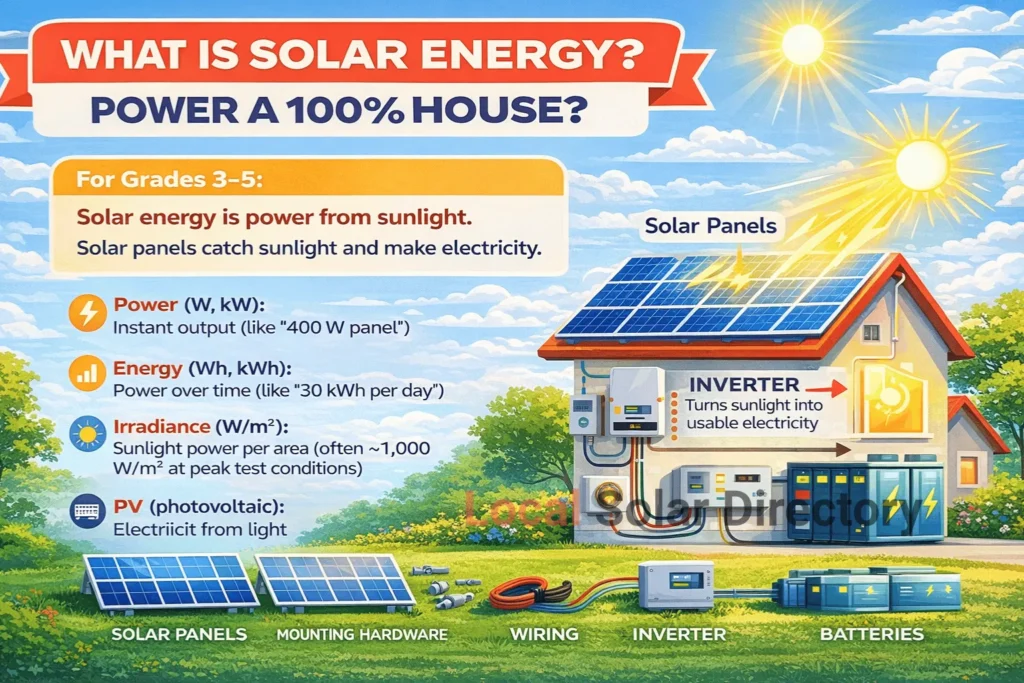
A solar energy system is a set of components—solar panels, mounting hardware, wiring, and an inverter—that converts sunlight into usable electricity; some systems also include batteries for storage.
For kids i explain simple defination which for grades 3–5: Solar energy is power from sunlight. Solar panels catch sunlight and make electricity. Some terms that use in this solar electricity.
- Power (W, kW): Instant output (like “400 W panel”).
- Energy (Wh, kWh): Power over time (like “30 kWh per day”).
- Irradiance (W/m²): Sunlight power per area (often ~1,000 W/m² at peak test conditions).
- PV (photovoltaic): Electricity from light.
- Solar thermal: Heat from sunlight.
How Does Solar Energy Work?
Solar energy works by converting sunlight into electricity in photovoltaic (PV) cells or converting sunlight into heat in solar-thermal collectors. PV systems generate direct-current (DC) electricity and an inverter produces alternating-current (AC) electricity that home appliances and the grid use.
- Absorb photons: A PV cell absorbs sunlight.
- Generate charge flow: The cell generates electron flow (DC electricity).
- Produce grid-quality power: An inverter converts DC to AC.
- Use or export: Electricity runs loads first; extra power can export to the grid (if interconnection and billing rules allow).
- Record energy: A meter tracks imported and exported kWh.
A simple physics sizing rule
- PV power ≈ Area × Irradiance × Efficiency
- Example: 1 m² × 1,000 W/m² × 20% ≈ 200 Wdc peak output.
Efficiency context
- A 2023 life-cycle assessment update from IEA PVPS (Task 12) used module efficiencies around 20.9% for mono‑Si and reported 35.8 g CO₂‑eq/kWh for a modeled rooftop mono‑Si PV system (Switzerland assumptions, 30‑year panel life, 15‑year inverter life).
What Are the Advantages of Solar Energy?
Advantages of solar energy include low operating emissions, low fuel cost (sunlight is free), modular scalability, and low cooling-water use for PV power plants. I put Advantages which are evidence-based.
- Low life-cycle greenhouse gas emissions compared with combustion generation: IEA PVPS Task 12 reported a modeled mono‑Si rooftop PV system at 35.8 g CO₂‑eq/kWh (2023 data update).
- Low operational water use for PV: The U.S. Energy Information Administration noted that wind and solar PV do not use cooling water, unlike thermoelectric plants that rely on steam-cycle cooling.
- Falling costs: IRENA reported the global weighted-average LCOE of utility-scale solar PV fell 12% from 2022 to 2023, and the LCOE of solar PV was 56% lower than the cheapest fossil fuel-fired alternative in 2023 (global weighted-average comparison framing).
- Fast deployment and modularity: Rooftop systems can add kW-scale capacity; utility projects add MW to GW-scale capacity. Global annual additions reached the hundreds of GW per year by 2024.
- No direct fuel-price volatility: Operating cost depends mainly on maintenance, insurance, and financing, not fuel purchases.
What Are the Disadvantages of Solar Energy?
Disadvantages of solar energy include variability (day/night and weather), seasonal mismatch, upfront capital cost, materials and recycling constraints, and grid integration limits.
- Variability: Output drops at night and during heavy cloud cover; output also changes seasonally with day length and sun angle.
- Grid constraints: High PV penetration can increase curtailment when generation exceeds local demand and transmission capacity.
- Upfront cost and financing: Many systems pay back over years, so financing terms influence economics.
- Land and siting: Utility-scale solar requires land area; dual-use options reduce land conflict (agrivoltaics, floating PV).
- Supply chain and materials: Silicon, glass, aluminum frames, copper, and silver are common PV materials; CSP uses mirrors and receiver materials.
What Are the Types of Solar Energy?
Types of solar energy are photovoltaic (PV) electricity, solar thermal heat, concentrated solar power (CSP) electricity, and passive solar design. I give the table of types of solar energy below summarizes what each solar type produces, what hardware it uses, and typical applications.
| Solar type | What it produces | Main components | Common uses |
|---|---|---|---|
| Photovoltaic (PV) | Electricity (DC → AC via inverter) | Modules, inverter, racking, wiring, meter | Rooftops, utility PV farms, off-grid |
| Solar thermal (low/medium temp) | Heat | Collectors, heat exchanger, storage tank | Water heating, space heating support |
| Concentrated Solar Power (CSP) | Heat → electricity | Mirrors, receiver, heat-transfer fluid, turbine | Utility-scale power, often with thermal storage |
| Passive solar | Reduced heating/cooling load | Building orientation, glazing, shading | Building design and retrofits |
CSP note: solar energy absorption: CSP systems concentrate sunlight and a receiver absorbs the solar energy to heat a working fluid, then the heat drives a turbine-generator. NREL describes four primary CSP configurations (parabolic trough, power tower, linear Fresnel, dish).
How Is Solar Energy Used?
Solar energy is used to generate electricity, provide heat, power remote systems, and supply industrial energy.
- Grid electricity: Utility-scale PV feeding transmission/distribution.
- Rooftop electricity: Behind-the-meter PV for homes and businesses.
- Battery-backed electricity: PV + batteries for outage resilience and time-shifting.
- Water heating: Solar hot-water systems for domestic use.
- Industrial heat: Process heat where temperatures match collector capability.
- Remote power: Telecom sites, sensors, and isolated loads.
What Is the History of Solar Energy?
History of solar energy includes the 1839 discovery of the photovoltaic effect, the 1954 first practical silicon solar cell, and large-scale cost declines and deployment growth in the 2000s–2020s.
Milestone timeline (selected)
- 1839: Edmond Becquerel observed the photovoltaic effect (light-induced electricity in an electrochemical cell).
- 1954: Bell Labs demonstrated a practical silicon solar cell (early efficiency ~6%).
- 1958: Vanguard 1 satellite used solar cells for power.
- 1970s: Oil shocks increased interest in alternative energy R&D.
- 2000s–2020s: PV manufacturing scale and technology learning drove large cost reductions and rapid global deployment.
What Are the Top Worldwide Solar Energy Companies?
Top worldwide solar energy companies vary by segment; by photovoltaic module shipments in 2024, leading manufacturers included JinkoSolar, JA Solar, and Trina Solar.
The table below lists the leading PV manufacturers by 2024 shipment volume (GWdc) as summarized in NREL’s Spring 2025 Solar Industry Update, citing SPV Market Research (April 2025).
| Rank (2024) | Company | 2024 shipments (GWdc) |
|---|---|---|
| 1 | JinkoSolar | 78.9 |
| 2 | JA Solar | 66.5 |
| 3 | Trina Solar | 63.3 |
| 4 | Tongwei | 59.6 |
| 5 | LONGi | 59.3 |
| 6 | Aiko Solar | 53.9 |
| 7 | Runergy | 50.9 |
| 8 | SolarSpace | 37.0 |
| 9 | Astronergy | 32.8 |
| 10 | Canadian Solar | 31.1 |
Other “top company” segments (examples, not a ranking)
- Inverters and power electronics: Huawei, Sungrow, SMA, SolarEdge, Enphase (segment leadership varies by region and system type).
- Developers / independent power producers: NextEra Energy Resources, Iberdrola, Enel, EDF Renewables, ACWA Power (scale varies by portfolio definitions).
- Thin-film PV: First Solar is a major CdTe manufacturer with large U.S. presence.
Which system is needed for solar energy storage?
Solar energy storage typically uses battery energy storage systems (BESS) to store electricity as chemical energy for later use.
- Lithium-ion batteries (LFP/NMC): High round-trip efficiency; dominant in residential and grid storage.
- Flow batteries: Longer duration potential; lower energy density.
- Thermal storage (mostly CSP): Store heat (often molten salt) and generate electricity after sunset.
- Pumped hydro / compressed air / hydrogen: Grid-scale or industrial pathways; site-dependent.
Why batteries dominate home solar storage?
Batteries dominate home solar storage becasue Batteries store DC/AC electricity directly. Batteries support backup power, time-of-use shifting, and self-consumption.
A sizing method (home backup)
- Calculate critical-load energy per day (kWh/day).
- Choose autonomy (days).
- Adjust for usable depth-of-discharge and inverter losses.
Example:
Critical load = 10 kWh/day, autonomy = 2 days, usable fraction = 0.9
Battery size ≈ (10 × 2) / 0.9 ≈ 22 kWh
Cost trend context
- IRENA reported battery energy storage project costs declined 89% between 2010 and 2023 (global trend).
- NREL summarized that the United States installed about 31.1 GWh (12.3 GWac) of grid storage in 2024, bringing cumulative capacity to 96.0 GWh (33.6 GWac).
What Is the Cost of Solar Energy?
Cost of solar energy is the combination of upfront system price, financing cost, operations and maintenance, and the value of electricity produced over the system life.
Cost benchmarks and ranges (useful reference points)
The table below lists common cost metrics and recent published ranges for PV and PV+storage; values vary by country, labor cost, permitting, roof complexity, and equipment.
| Cost metric | What it measures | Example published values |
|---|---|---|
| Residential PV price ($/Wdc) | Installed price per DC watt | Median gross cost $2.65/Wdc (U.S., 2H 2024, EnergySage data summarized by NREL). |
| Utility PV price ($/Wac) | Installed price per AC watt (large projects) | Median $1.51/Wac in 2024; low/high reported $1.22–$2.92/Wac (NREL summary). |
| LCOE ($/MWh) | Levelized cost per MWh over plant life | Lazard (2024) estimated utility-scale solar PV $29–$92/MWh unsubsidized; $19–$78/MWh with ITC; PV+storage $60–$210/MWh unsubsidized. |
| Global LCOE direction | Global trend | IRENA reported utility-scale solar PV LCOE fell 12% from 2022 to 2023 (global weighted average). |
How to calculate a solar energy budget (step-by-step)
A solar budget is a calculation of system size (kW) and total installed cost ($) needed to meet a target annual energy (kWh/year).
Step 1: Calculate annual electricity use
- Use utility bills to sum kWh/year (12 months).
Step 2: Estimate local solar production per kW
- Use a solar resource estimate (often expressed as kWh per kW per year).
Typical values range roughly 1,000–1,800 kWh/kW-year depending on latitude, shading, tilt, and weather.
Step 3: Calculate required PV system size
- PV size (kW) = Annual kWh ÷ (kWh per kW-year)
Example:
Annual use = 10,000 kWh/year
Local yield = 1,400 kWh/kW-year
PV size ≈ 10,000 ÷ 1,400 ≈ 7.1 kW
Step 4: Estimate installed price
- Installed cost = PV size (W) × price ($/W)
Example: 7.1 kW = 7,100 W
At $2.65/Wdc → cost ≈ 7,100 × 2.65 = $18,815 (equipment + installation pricing context; taxes/fees vary).
Step 5: Decide storage budget (optional)
- Battery size depends on backup goal:
- “Evening shifting” often targets 5–15 kWh usable.
- “Whole-home backup” often targets 20–60+ kWh depending on loads.
- Battery pricing often uses $/kWh of battery capacity. NREL summarized a California median in 2024 of $3,074/kWh of battery for residential PV-plus-storage systems.
Step 6: Include ongoing costs
- Cleaning, inverter replacement (often once in 10–15 years), insurance, monitoring, and minor repairs.
What Are Solar Energy Stocks?
Solar energy stocks are publicly traded shares of companies that manufacture solar components, develop solar projects, or provide solar services.
Main solar stock categories
- Upstream: Polysilicon, wafers, cells.
- Modules: Panel manufacturers.
- Inverters & power electronics: String inverters, microinverters, optimizers.
- Trackers & racking: Utility-scale mechanical systems.
- Developers & operators: Build/own solar plants.
- Residential installers / financiers: Customer acquisition and rooftop deployment.
- Storage-linked solar: Battery suppliers and integrators.
Examples (company names, not recommendations)
- Module and manufacturing: JinkoSolar, Canadian Solar, First Solar.
- Inverters: Enphase Energy, SolarEdge (segment depends on market).
- Residential: Sunrun (U.S. residential-focused).
- Trackers: Array Technologies, Nextracker (tracker-focused businesses).
“Options for homes” (home solar ownership/contract structures)
- Cash purchase: Homeowner owns system; higher upfront cost.
- Loan: Homeowner owns system; monthly payments.
- Lease: Third party owns; homeowner pays fixed lease payment.
- Power purchase agreement (PPA): Third party owns; homeowner buys kWh produced at contract price.
Home solar ownership structure changes who captures incentives and who maintains equipment.
Do Solar Panels Produce Electricity at Night?
Solar panels do not produce meaningful electricity at night because PV cells require sunlight to generate current.
Night-time electricity for a solar-powered home comes from:
- Grid electricity (grid-tied systems), or
- Battery storage (PV-plus-storage), or
- Other generation (generator, wind, microhydro).
Small electrical output from moonlight or artificial lights exists but is negligible for household loads.
How Does AI Affect Solar Energy?
AI affects solar energy by improving forecasting, operations, maintenance, manufacturing quality, and grid coordination.
Operational areas where AI changes solar performance are solar forecasting, Fault detection, predictive maintenance and Dispatch and distributed coordination.
- Solar forecasting: NREL’s solar forecasting review describes solar forecasting as valuable for utility operations because lower forecast error supports grid stability and can reduce reserve requirements; recent work includes deep learning and computer vision methods.
- Fault detection and predictive maintenance: Data-driven monitoring can detect string-level underperformance, inverter faults, shading changes, and soiling patterns using high-frequency telemetry.
- Dispatch and distributed coordination: NREL’s generative AI grid-operations work discusses probabilistic forecasting and grid coordination as key needs for integrating variable renewables and storage.
AI and the “future of solar energy” (technology trends already visible)
- IEA PVPS Trends in PV Applications 2025 noted manufacturing and market shifts such as n-type technologies ~70% of global production, bifacial modules >75% of production, and growth in dual-use applications like agrivoltaics and floating PV.
What Are the Facts About Solar Energy?
Facts about solar energy include rapid global deployment, measurable cost declines, and improving module technology and life-cycle footprint.
High-signal facts (with numbers)
- Global installed PV capacity: IEA PVPS reported cumulative installed PV capacity surpassed 2,260 GW by end of 2024 (29% year-on-year increase).
- Annual PV additions: IEA PVPS reported 553–601 GW newly installed worldwide in 2024.
- Module manufacturing concentration (shipments): NREL summarized 2024 shipments led by JinkoSolar (78.9 GWdc) and JA Solar (66.5 GWdc) among top manufacturers.
- Life-cycle GHG of PV electricity (example system): IEA PVPS Task 12 reported 35.8 g CO₂‑eq/kWh for a modeled rooftop mono‑Si PV system (2023 update assumptions).
- Cost direction: IRENA reported utility-scale solar PV LCOE fell 12% from 2022 to 2023 and solar PV LCOE compared favorably against fossil alternatives in global comparisons.
- Cooling water: EIA noted wind and solar PV do not use cooling water, unlike many thermoelectric plants.
What Is Solar Energy Credit?
Solar energy credit is a financial value assigned to solar electricity or solar equipment costs, commonly delivered as a bill credit, a government tax credit, or a tradable certificate credit.
1) Bill credit (net metering / net billing)
- A utility bill credit is a kWh or dollar credit applied when a customer exports electricity to the grid under the local billing tariff (terms vary by jurisdiction).
2) Government tax credit
- A tax credit reduces tax liability based on eligible solar costs (rules vary by country and tax year).
- In the United States, the IRS describes the Residential Clean Energy Credit as 30% of qualifying costs for eligible property placed in service from 2022 through December 31, 2025, and notes that battery storage technology can qualify beginning in 2023 (capacity requirement applies).
3) Tradable certificate credit (RECs / SRECs)
- A renewable energy certificate (REC) represents the environmental attributes of 1 megawatt-hour (MWh) of renewable electricity generation; some markets have solar-specific RECs (SRECs).
Are Solar Energy Kits Worth It?
Solar energy kits are worth it for a house when the kit delivers electricity at a lower total cost than alternatives and the installation meets electrical safety, permitting, and interconnection requirements.
Objective checks (house context)
- Cost per delivered kWh: Total installed cost ÷ lifetime kWh delivered. Compare with local retail electricity price.
- Design fit: Roof shading, tilt, and available area match required kW.
- Compliance fit: Local permitting, inspection, and utility interconnection allow homeowner installation.
- Risk fit: DIY installation increases risk of wiring errors, roof leaks, and warranty gaps; professional installation reduces those risks but adds labor cost.
Common kit limitations
- Many kits cover PV modules and balance-of-system hardware but exclude:
- Permit plans and structural engineering
- Utility interconnection paperwork
- Roof work (flashing, structural reinforcement)
- Installer labor warranty
Can Solar Energy Power Run a 100% House?
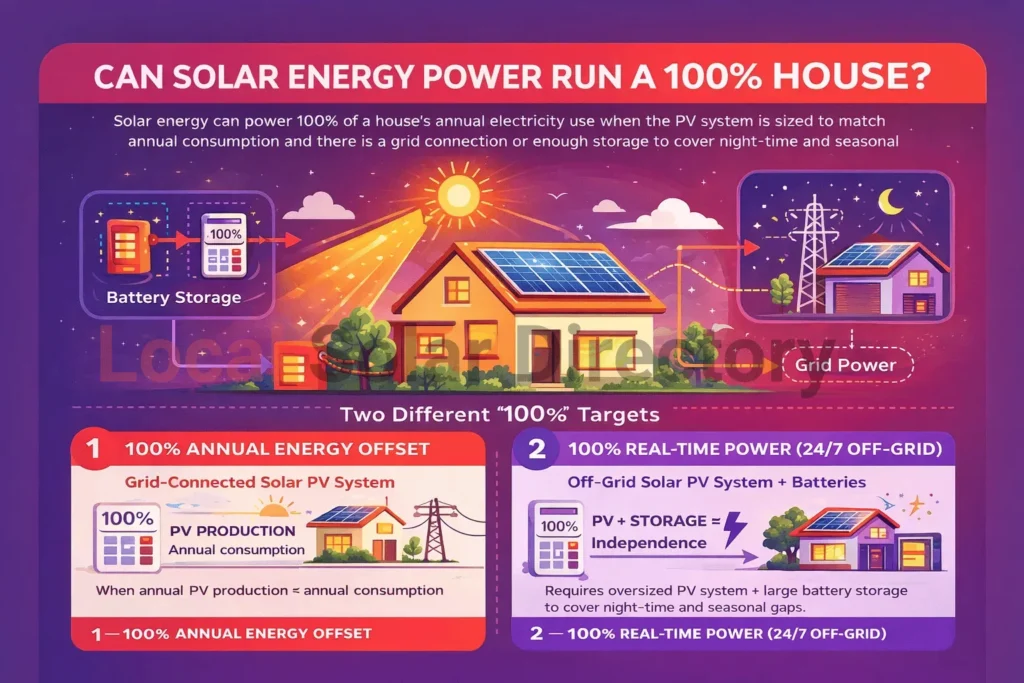
Solar energy can power 100% of a house’s annual electricity use when the PV system is sized to match annual consumption and the household has a grid connection or enough storage to cover night-time and seasonal gaps. Here are two different methods “100%”
- 100% annual energy offset (kWh/year): Achievable with grid-tied PV when annual production ≈ annual consumption (billing rules affect economics).
- 100% real-time power (24/7 off-grid): Achievable only with enough storage and overbuilding to handle multi-day low-sun periods and seasonal shifts.
You can see also in image who shows in comparison two different methods where the chances are 100%.
A practical sizing relationship
- Required PV size depends on local yield:
PV (kW) = Annual kWh ÷ (kWh per kW-year) - Required battery size depends on backup goal:
Battery (kWh usable) = Daily critical kWh × autonomy days ÷ usable fraction
